
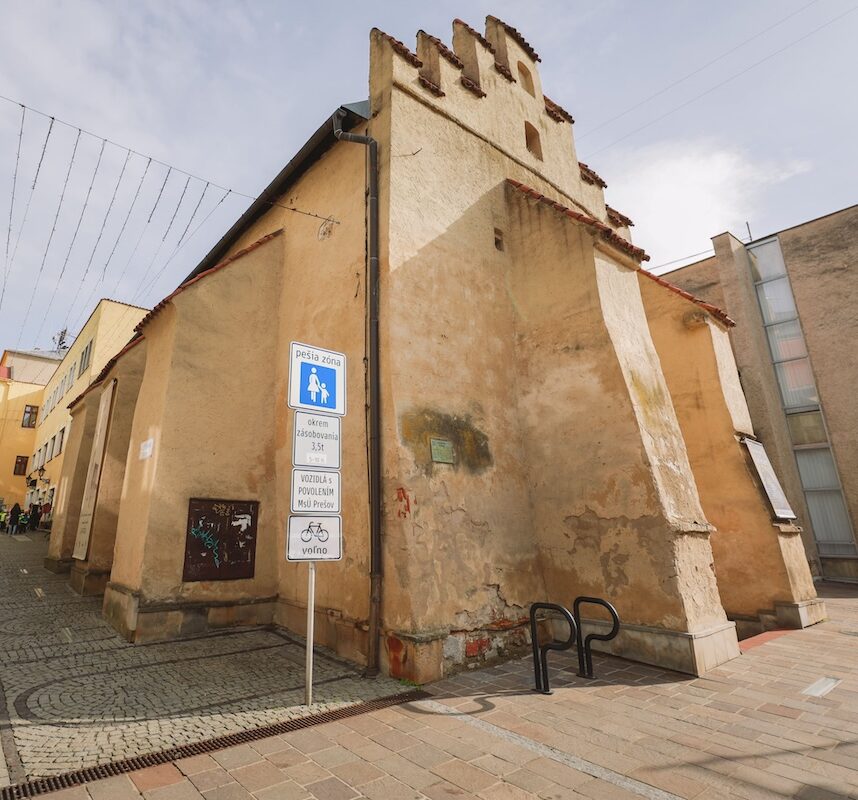
Caraffa Prison is one of the most interesting historic buildings in the city centre Prešov. This unassuming yet architecturally striking building stands at the junction of Jarková and Floriánová Streets, right next to Prešov Town Hall and just a few steps from Hlavná Street. It is one of the few surviving Gothic monuments in the city and also a national cultural monument with a history stretching back more than five centuries.
It attracts visitors not only with its mysterious past, but also with its distinctive high stepped gable, thick walls and historic rooms, which today serve as venues for culture and the visual arts.
From a wine cellar to the town prison
The building was constructed between 1504 and 1509 at the rear of a medieval plot of land which the town had purchased from Peter Moler, a painter from Prešov and a member of the town council. At the front of the plot, the original house was converted into a municipal wine bar – this part now houses Prešov Town Hall.
The newly built rear building served primarily as a storehouse for barrels, wine and other equipment needed to run the wine bar. It probably retained this function until the end of the 17th century. However, archival records dating back to 1530 also mention it in connection with the town prison, which may have been due to its location right next to the town hall and other municipal administrative premises.
The Bloody Massacre in Prešov
Caraffa’s Prison got its current name from the events known as the Prešov Bloodbath. In 1687, following a special court-martial, the imperial general Antonio Caraffa ordered the execution of 24 Hungarian nobles and burghers who had been accused of plotting against Emperor Leopold I.
The executions took place not far from the Evangelical College, roughly where the Immaculata sculpture now stands. Before their sentences were handed down, the accused were subjected to brutal interrogation and torture; one of the torture chambers is said to have been located in the underground chambers of what is now the Town Hall. At that time, the Town Hall and the building later known as Caraff’s Prison formed an interconnected complex of buildings.
Were the Caraffs’ accused actually being held in the building?
Despite the commonly used name, it is not entirely certain whether the Caraffa prisoners were held in this very building in 1687. Historical sources do not provide conclusive evidence, and expert opinions differ.
During that period, the main city prisons were mainly located in the bastions of the city’s fortifications. However, as around a hundred people were arrested during Caraff’s special tribunal, historians admit that some of the accused may also have been temporarily held in premises near the town hall. The name ‘Caraff Prison’ is therefore primarily a reminder of one of the most tragic events in the history of Prešov, rather than an indisputable confirmation of the building’s original function.
Armoury, storehouse and prison
Over the following centuries, the building’s use changed several times. According to surviving documents, the town’s standard measures and weights were kept here, and for a time the building also served as an armoury.
A proposal dating from 1864 called for the conversion of the premises into a municipal prison with five cells, a women’s wing and the jailer’s flat. However, according to later heritage research, not all of the planned alterations were actually carried out. In period photographs from the turn of the 19th and 20th centuries, small shops facing Floriánova Street can also be seen along the outer walls.
The Town Archives and discoveries made during research
At the beginning of the 20th century, the building began to house the town’s records. Following alterations carried out in the second half of the 20th century, the upper floor served as the town archive and registry office, which were linked to the town hall.
The building was cleared in 2007, and subsequent architectural and historical research yielded a number of remarkable discoveries. Experts found older structural elements suggesting that part of the building may have incorporated an even older tower-type house.
A shooting gallery and a so-called ‘black kitchen’ – a windowless room with an open hearth connected directly to the chimney – were discovered in the attic. However, these areas are not normally open to the public.
The mysterious „bunker“ and preserved historical features
Inside, the historic window jambs and a portal dating from the late 16th century have been preserved; this portal originally provided access to the upper floor via an external staircase.
A distinctive feature of the building is the so-called bunker, an enclosed room without conventional windows or doors, which can be seen from the first floor. Inside, there is a wooden ladder, several wooden planks and a fragment of an old toilet. It is thought that the space may have been prepared as a shelter during the Second World War.
These details, too, lend the tour of the building an air of mystery and serve as a reminder of the many different functions the building has served over the centuries.
The conversion of a historic building into a gallery
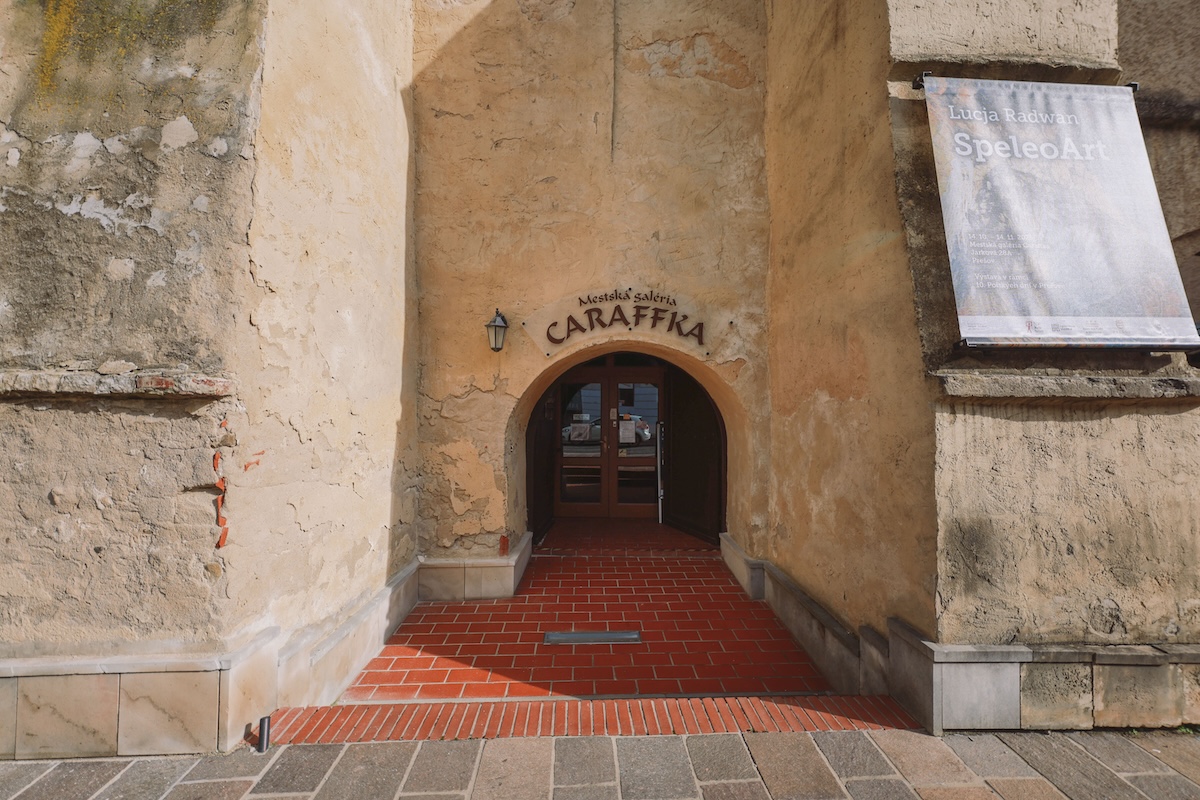
Extensive renovation work on the Caraffka Prison took place between November 2010 and February 2012. The restored building was officially opened on 1 March 2012 and has since been home to the Caraffka Municipal Gallery, which is managed by the Prešov Culture and Leisure Park.
The historic building has thus been transformed into a vibrant cultural venue hosting exhibitions by both professional and amateur artists, exhibition openings, creative workshops, lectures, seminars, book presentations, chamber concerts and programmes for schools and families with children.
The gallery is also linked to the Prešov Montmartre street festival and other events that bring the historic city centre to life.
Caraffa Prison today
Today, Caraffa Prison serves neither as a prison nor as an archive, but as a municipal gallery and a venue for cultural, educational and community activities. Visitors can view changing exhibitions of fine art whilst exploring the authentic interiors of one of the oldest buildings in Prešov.
Thanks to the combination of historic architecture and contemporary art, Caraffa Prison is one of those places that offers more than just a traditional gallery visit. The building itself is, in fact, a significant exhibit and a reminder of the city’s development from the late Middle Ages to the present day.
Source: OOCR RŠ
source of photographs: OOCR RŠ
Map
Gallery


Information
Caraffa’s Prison is located in the historic centre of Prešov at 28/A Jarková Street, right next to the town hall and just a few minutes’ walk from Hlavná Street, St Nicholas’s Co-Cathedral and the Neptune Fountain.
This striking Gothic building with a stepped gable no longer serves as a prison or an archive – it is now home to the Caraffka Municipal Gallery. It hosts art exhibitions, private viewings, creative workshops, lectures, chamber concerts and other cultural events.