
In the second half of the 13th century, the Veľký Šariš early Gothic majestic temple, which is as old as the castle above it. Around the same time, a monastery began to be built under the castle, initiated by King Béla IV. The monastery was initially inhabited by the mendicant monks, the Wilhelmites, who later adopted the regulation of St. Augustine and were called Augustinians from then on. The monastery had an important role. It fulfilled the function of a place of trust, i.e. Locus credibilitati, where the legal validity and authenticity of official documents were verified or confirmed. The superior was even the chief vicar of the entire of the Diocese of Jagger. The monastery ceased to exist around 1541 as a result of the Reformation. On the site of the former monastery stands today The Chapel of St Kunhuta (Kunigunda).
The chapel was built sometime after 1544 using the walls of an older building. It forms the lower part of the western wall of the building. Architectural elements from the early Gothic period, probably from the ruined monastery, were used in the construction.
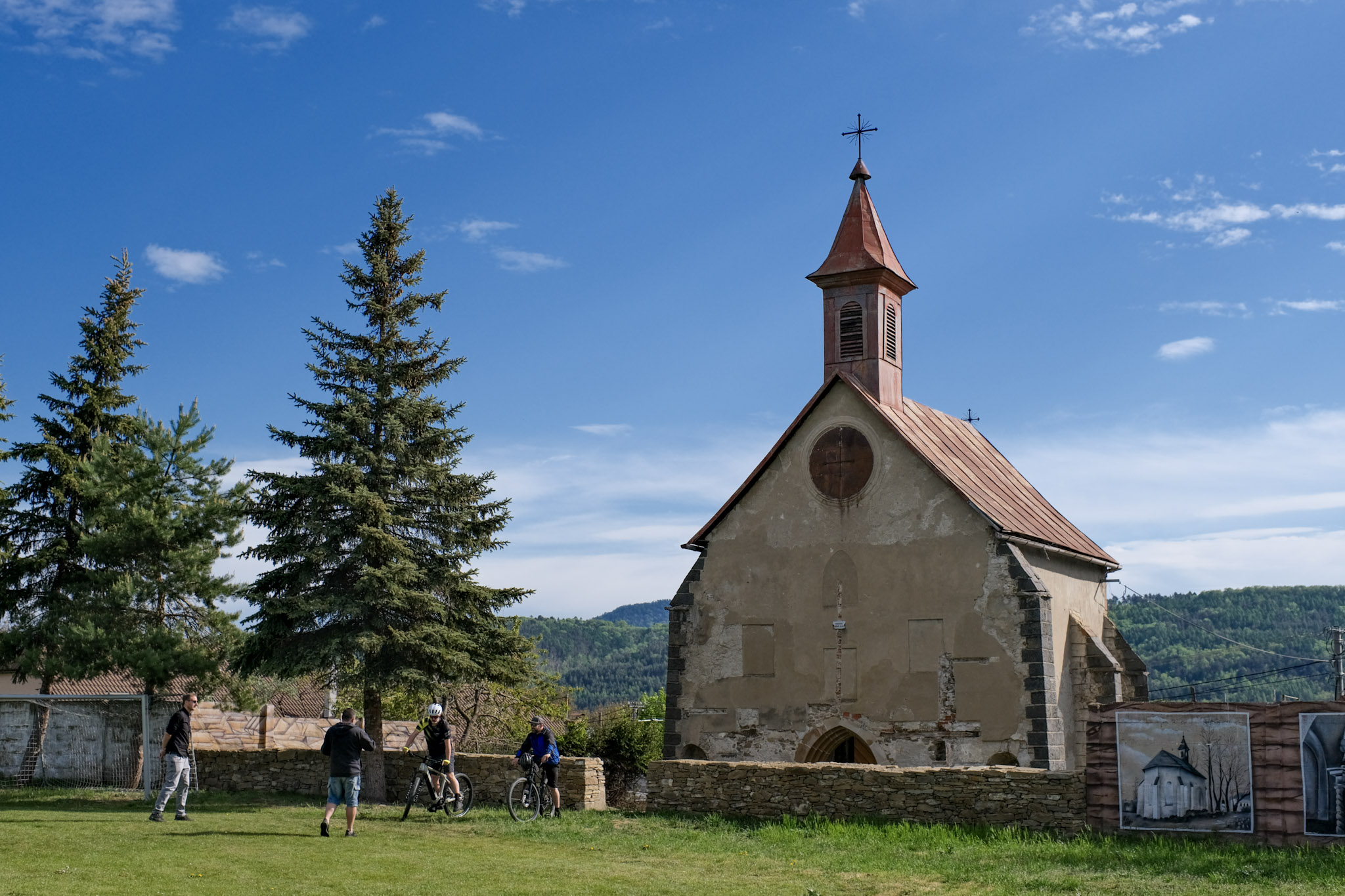
The chapel has a short rectangular nave and a pentagonal sanctuary. It was repaired in 1599 by the Šariš count František Dershfi de Zerdaheyla, as evidenced by the initials on the façade FD 1599 DZ. It is a sgraffito inscription with a stylized lily. The chapel was the family chapel of the Rákoczy and represents valuable original preserved Gothic architecture without later modifications.
Renewals over the centuries
During the turbulent 17th century, the chapel served as a granary for some time, and in this context it was also structurally modified (divided into two floors and the lower parts of the windows bricked up).
Sometime after 1769, the building was again adapted for liturgical purposes, removing the built-in floor. The chapel also received a new roof covered with shingles, later the shingles were replaced by metal roofing.
Extensive repairs were carried out in 1965, thanks to which the chapel was made "operational" for occasional services and pilgrimages. However, it was not done in accordance with the ideas of the preservationists. In recent years, efforts to save the dilapidated building have been renewed, with expert research being carried out (2010-2011). These have helped to clarify the building's evolution.
Today the chapel stands in an unusual place - by the football field. Until recently it was considered to be an early Gothic building, the presbytery of an unbuilt monastery church. This dating was based on the form and decoration of the ribs and the heads of the arches or the lining of the windows. Recent research has shown that they were used secondarily from an earlier building. Crucial to the change in the date of the chapel was research on the west front of the building, which showed that the lower part of the masonry was older.
Life of Saint Kunhuta
Saint Kunigunda lived at the turn of the 10th-11th century. Together with her husband, St. Henry II, they were crowned Emperor and Empress by Pope Benedict VIII. She lived the last 15 years of her life as a nun. She was canonized by Pope Innocent III in 1200. Her cult is unique in our country, she is popular mostly in German countries.
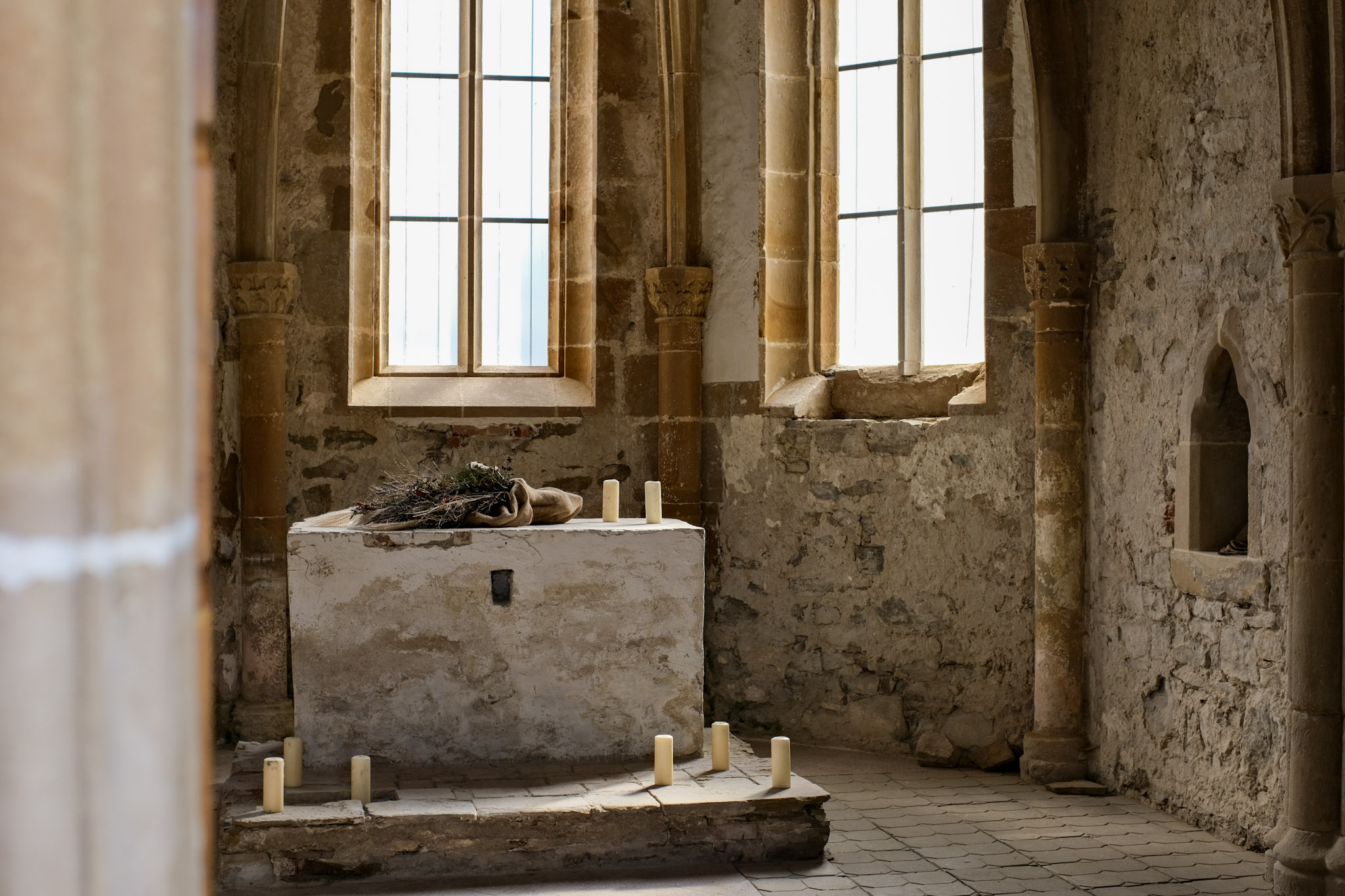
The chapel has several interesting features: it has no windows on the south wall of the "nave", on the contrary, one is located unconventionally on the north side, the nave and sanctuary space is not separated by a triumphal arch, only by simple ribs of the vault, the heads of the aisles supporting the vault are decorated with plant motifs - oak and vine leaves, in the south wall there is a niche in the shape of a nun, and in the west wall there is a Gothic portal.
Source: apsida.sk, Town of Veľký Šariš – Veľký Šariš through the ages
Source of photographs: OOCR RŠ
Map
Gallery



Information
The Chapel of St Kunhuta is situated in Veľký Šariš, next to the football pitch; the chapel can be reached on foot from Hlavná Street, where you can park your car. You can also get here from Prešov by public transport, using bus route no. 45.
The interior is mainly open to the public during events and guided tours, so it is advisable to check the dates of your visit in advance.