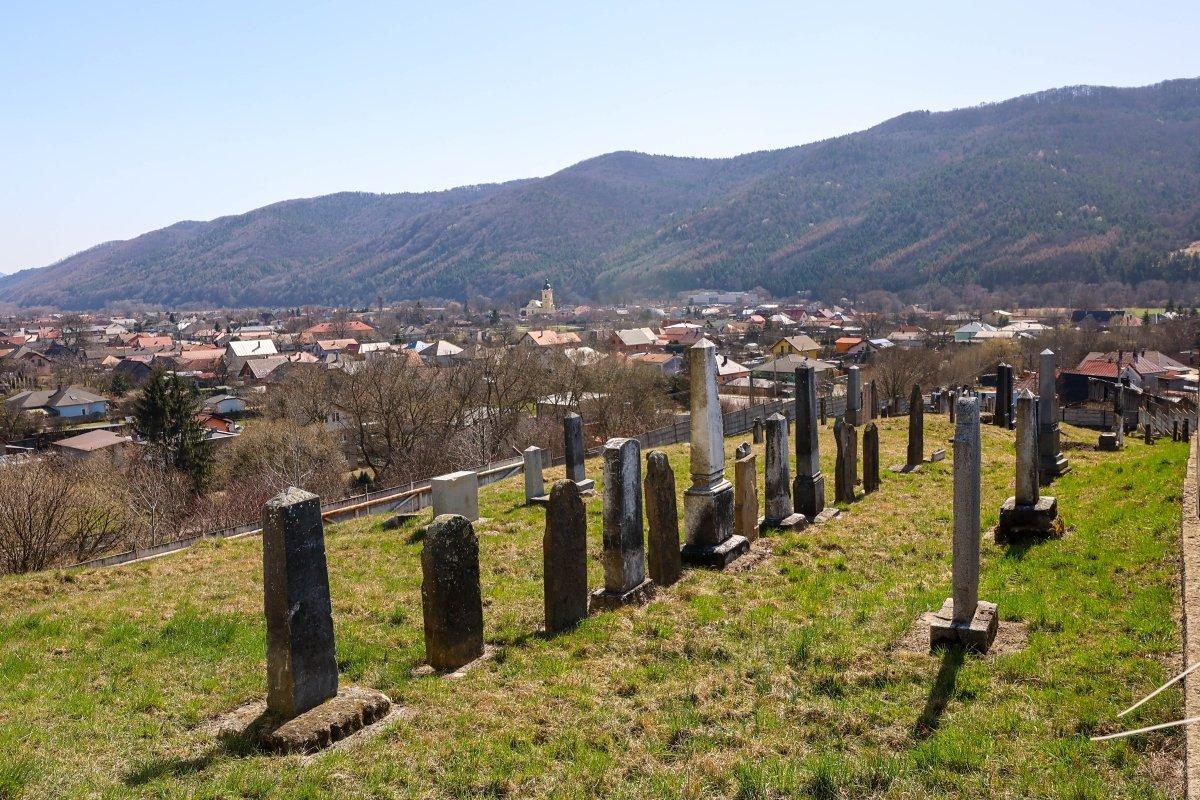

In the 18th and 19th centuries, a large number of people lived in the village of Pečovská Nová Ves Jewish community. Following the tragic events of the Second World War, the only remnant of this community in the village was the cemetery, which is situated on a hillside Monks. The rectangular cemetery grounds are enclosed by concrete panels. A total of around 100 gravestones are arranged in five rows.
The artistic value of the memorial site
The artistic and historical value of the cemetery lies in its artistically and architecturally crafted gravestones – which come in various forms and express a range of symbolic, functional or decorative meanings. The gravestones are predominantly monolithic. The building material used was, for the most part, sandstone, with a smaller quantity of coarse-grained and fine-grained grey marble.
Several gravestones are damaged and have fallen over. Most date from the 19th century, some from the 20th century, and the oldest are from the late 18th century. The most significant gravestone is a small, freestanding structure from the 20th century. At the entrance there used to be a catafalque hall, accessed via a flight of steps. On the higher side of the cemetery stood three obelisks (now in ruins). The gravestones are characterised by fine sculptures and ornamentation. The cemetery is a rare testament to the once-prosperous and large Jewish religious community in Pečovská Nová Ves.
The last rabbi who worked here was Naftali Soffer, who died in 1899 and is buried here in a brick tomb. After 1990 the cemetery became the property of the municipality, in 1997-2000 the cemetery was fenced and the tombstones rebuilt.
Source: pecovska.sk
Source of photographs: eurovelo11.sk
Map
Information
The place is more of a site of remembrance and historical interest than a traditional tourist attraction.
The cemetery is now enclosed by concrete panels and underwent restoration after 1990: between 1997 and 2000, it was fenced off and the gravestones were re-erected. It is advisable to check with the local council regarding access.