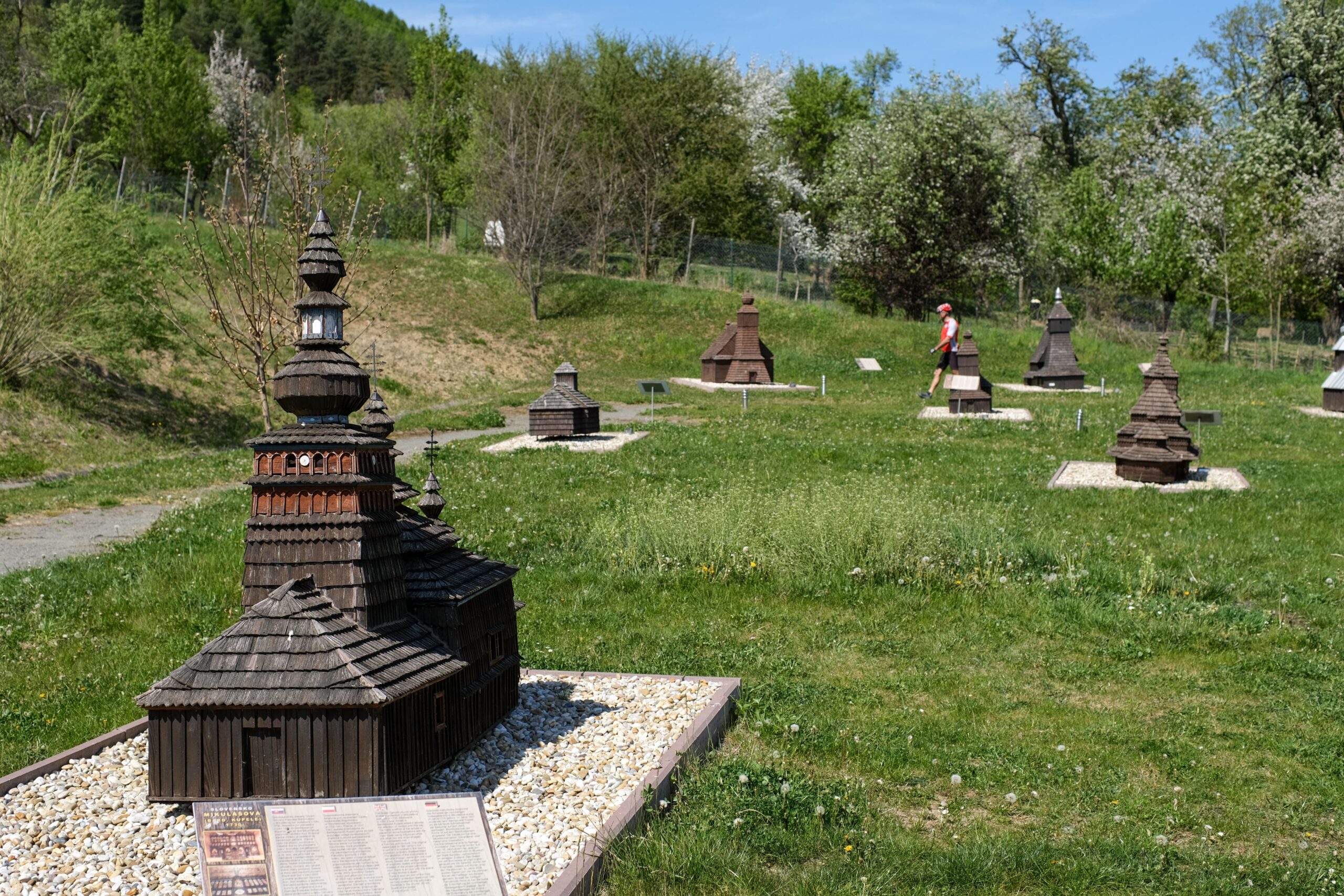


The wooden Greek-Catholic church in Miroli was built on a dominant platform in 1770. It is dedicated to the Protection of the Most Holy Mother of God. It has a characteristic log construction and a three-part external and internal structure. Even in this church, the Church Slavonic language is still used in worship.
It is a three-space sacral building of the Lemko type. Externally, the three-space character is emphasised by stepped pyramidal roofs. The tower stands separately outside the log part on four supporting columns. Externally, the entire structure is sheathed with boards and a tiled roof. The upper third of the tower is vertically plated, with small echo openings. The roof of the tower is pyramidal with a flat onion set into the roof, continuing into a hint of a lantern. Above its roof is a smaller onion and above it a three-armed cross.
The iconostasis dates from the period of the temple's construction. Interesting are the middle tsar's doors from the end of the 17th century. The door is fitted with six medallions, two Annunciation medallions and medallions of the four Evangelists. The iconostasis has undergone several repairs. The last restoration was carried out in 1977-1979, and the repair of the Tsar's door in 2008. Behind the iconostasis there is an altar with a 19th century icon of Christ carrying the cross with a carved rusticated-rock frame. On the side altar there is a relief of the Crucifixion from the middle of the 18th century.
The walls of the church are decorated with a rich gallery of icons, which probably come from an older wooden church from the end of the 17th century.
Liturgical objects found during the various repairs of the church are placed in the narthex. Particularly noteworthy is a rare cloak, probably from the 17th century. It is a large icon on canvas, depicting the Laying of Christ in the tomb, which was found in 2004 stored inside the altar.
A special section is the rare books used in worship, mostly from the 17th century, which have contemporary notes about donors and other facts at the bottom of the pages.
Source : www.drevenchramy.sk
Photos by Tomáš Šereda, Henryk Bielamowicz