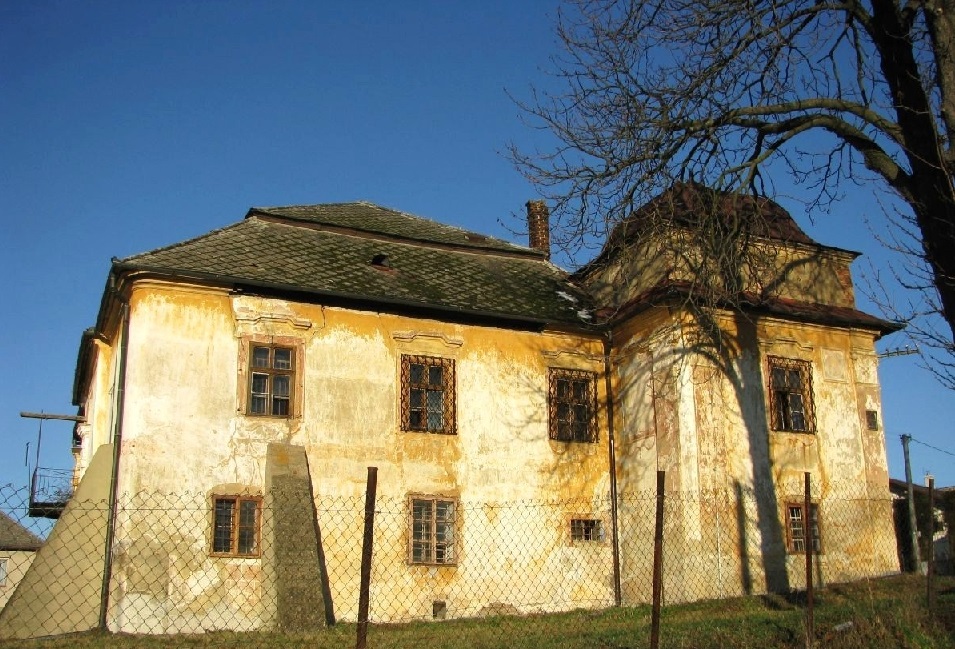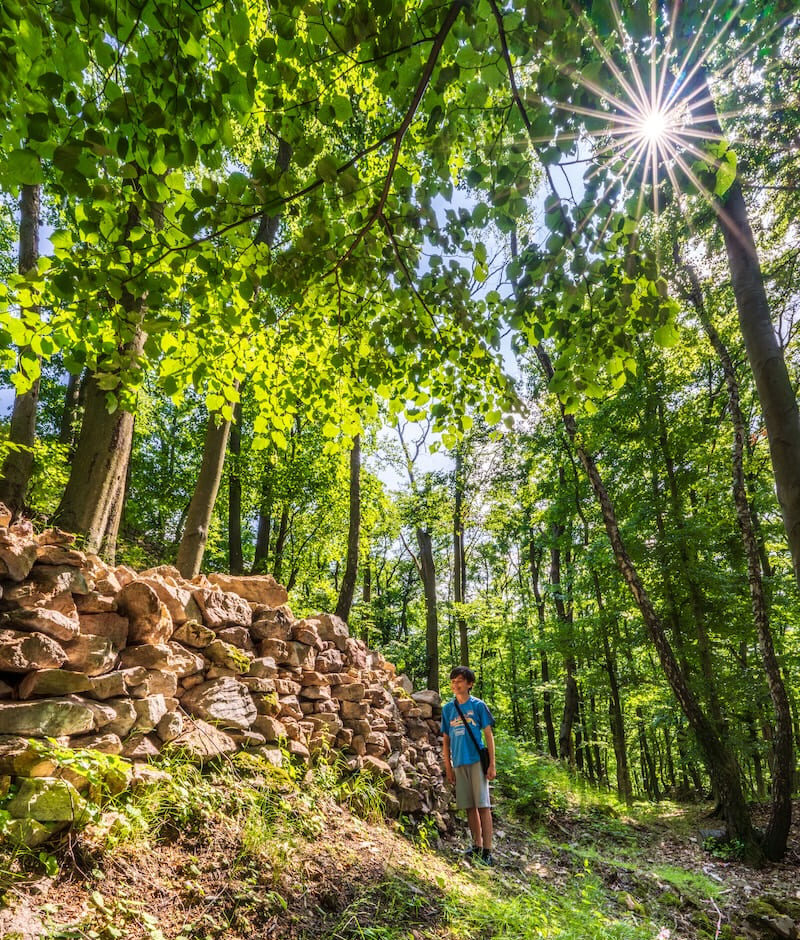

Kysacký Castle, also known as Kysak Castle, is situated above the village of Kysak on Hrad Hill, at an altitude of approximately 498 metres. Today, all that remains are the ruins of the medieval fortifications, which bear witness to its former importance. The castle was probably built at the end of the 13th century, and its location was primarily linked to the need to control the passage through the narrow valley of the River Hornád.
The first written records of the castle relate to the estates of the Drienov branch of the Abov family. In historical sources, the castle also appears under the name ‘castrum Sumus’, meaning Drienov Castle. Throughout the Middle Ages, it was linked by ownership to the families who held the surrounding estates, with the castle itself serving as their fortified residence and, at the same time, as a strategic vantage point overlooking the Hornád.
Location and strategic importance
The choice of location was no accident. The castle stood on a long, narrow rocky ridge, which provided natural protection whilst also allowing control over the surrounding area. Its position was particularly advantageous from a defensive point of view, as the castle could monitor movement in the Hornád valley and along the roads in the wider area. The defences were supplemented by ramparts and moats.
The limited space available on the rocky ridge also influenced the castle’s very design. The castle complex was not extensive, and its individual structures were adapted to the terrain. Judging by the surviving remains, the complex comprised defensive and residential sections. Prominent features included the western cylindrical tower and the eastern prismatic tower, which was connected to the residential part of the castle.
The Castle and the Abov Family
The castle was primarily associated with the Drienov branch of the prominent Abov noble family. During the 14th and 15th centuries, it appears in written sources in connection with the division of estates and the administration of the surrounding manors. At that time, Kysak formed part of the territory administered by the castle manor.
The castle is also linked to a legend about the Hungarian King Matthias Corvinus. According to local historical records and tradition, he often hunted in this area. However, this connection is more a part of the castle’s legendary lore than of its clearly documented architectural or political history.
Decline and gradual deterioration
The exact date of the demise of Kysacký Castle is unknown. Its importance began to wane gradually, particularly in the second half of the 15th century. Following the extinction of the Drienov branch of the Abov family, the castle became royal property and gradually lost its original function. According to available sources, by the early 16th century it was already uninhabited and gradually fell into ruin.
Another factor contributing to its decline was the fact that the new owners of the surrounding estate had their own residences, and the castle no longer served as such an important residential centre for them. As it gradually fell into disrepair, its walls crumbled, and only the ground-level and structural remains have survived to the present day.
Archaeological research
The remains of the castle were the subject of an archaeological investigation carried out between 1991 and 1993. During the investigation, ceramic and metal fragments were discovered. The finds were professionally conserved and displayed at specialised exhibitions. The research helped to better document the castle’s existence and architectural development.
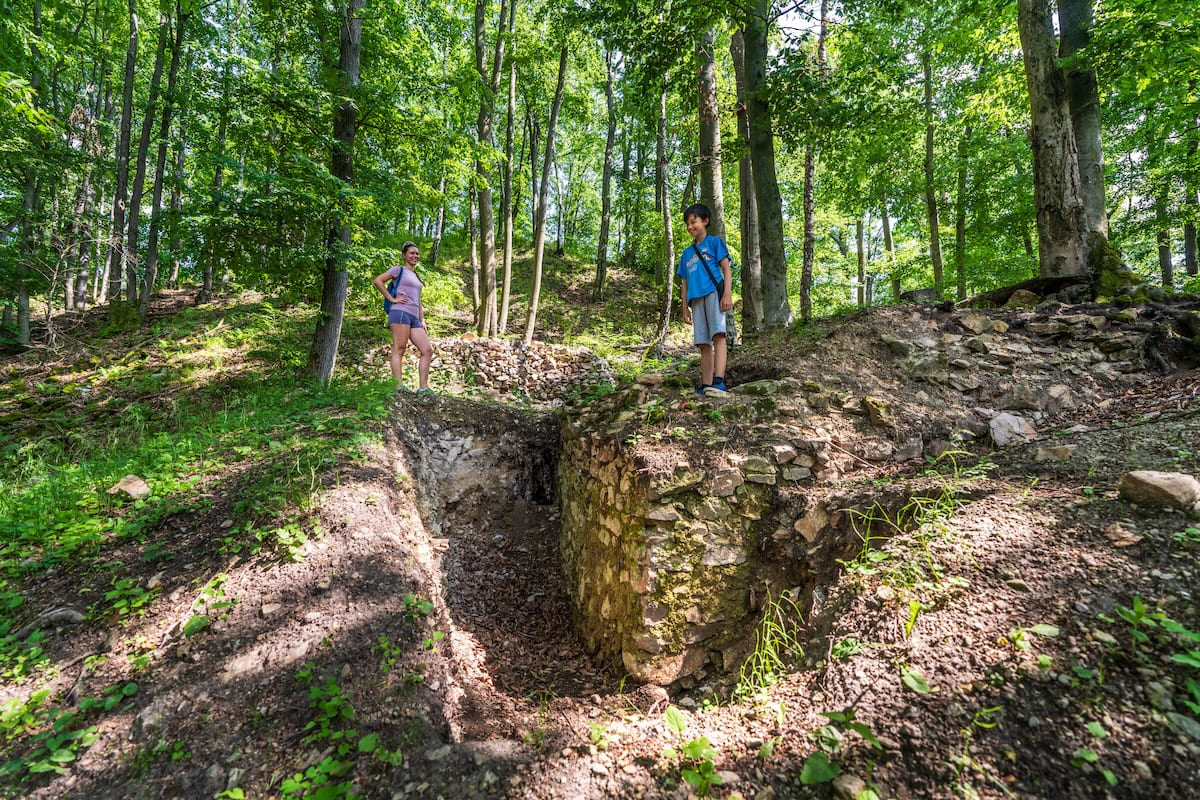
Today, the outlines of the original fortifications and residential quarters can still be made out on the castle hill. Although the surviving remains do not allow for a complete reconstruction of the castle’s original appearance, visitors can identify its basic layout whilst on site.
The castle as a tourist destination
Today, Kysak Castle is primarily a destination for easy hikes and trips into the countryside. Forest tracks and footpaths lead from the village of Kysak to its ruins. The walk allows visitors to combine a visit to this historic site with a stroll through the surrounding countryside.
The castle’s location within the wider natural landscape of Čierna Hora is also of interest. From the surrounding hills, one can see the Hornád valley and the surrounding hills. Kysacký Castle thus represents a place where the history of a medieval settlement meets the natural character of the landscape around Kysak.
Kysak Castle is a part of Šariš Castle Road
Source: OOCR RŠ
Source of photographs: OOCR RŠ
Map
Gallery
Information
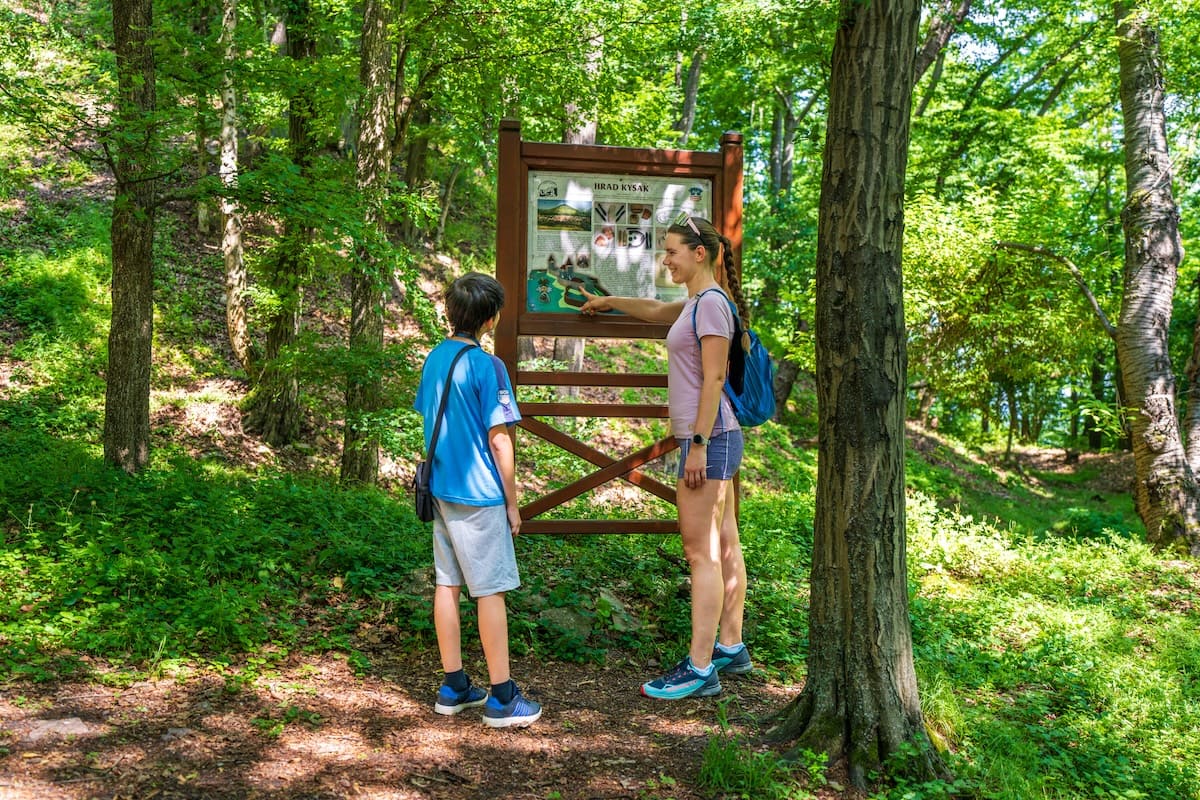
The climb to Kysacký Castle begins right in the village of Kysak. A footpath leads from the village towards Hrad Hill, where the ruins of the former castle are situated. The route continues through woodland and gradually climbs towards the castle grounds.
This is an easy to moderately challenging walk suitable for walkers and families with older children. The route consists mainly of forest paths and unpaved terrain, so sturdy walking boots are recommended. After rain, the path may be muddy and slippery.
The walk itself from Kysak to the ruins takes around 30 to 45 minutes, depending on the route chosen and your pace. You can treat the visit as a short walk or combine it with further hiking in the area around Kysak and Čierna hora.
The castle grounds are freely accessible and there is no admission charge. There is no ticket office on site, nor are there regular guided tours. When visiting, please bear in mind that this is a ruin set in natural surroundings with no extensive tourist facilities.