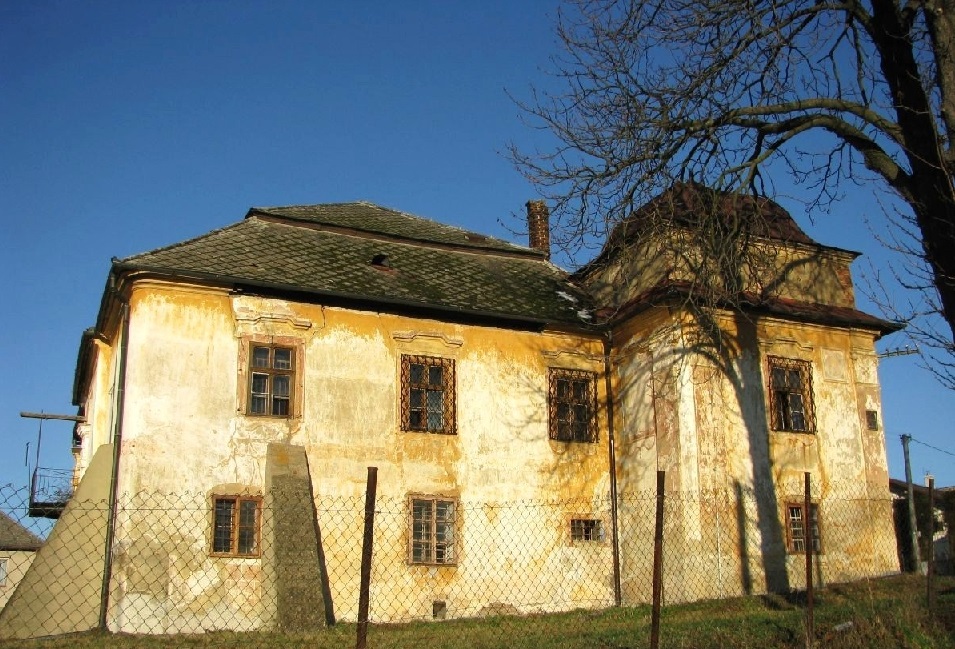

The manor house was built on the ruins of the former Augustinian monastery and it is assumed that it was also built from the building material of this monastery. According to the preserved morphological features, it was built sometime in the 17th century. In 1645 the castle estate of Šariš was acquired by the Rakoci family. Previously, the estate was owned by the Perényi family, who also owned Šariš Castle. Of the Rákoci family, the most famous owner was František Rákoczi II, who was also solemnly appointed hereditary count of the Šariš County and called the „Count of Šariš“. In 1701, in connection with the preparation of the Estates Uprising, he was arrested and taken to Prešov for interrogation.
After František Rákoci, the manor house was owned by his sister Julia de Aspermont, later by the Sirmay family and in the 19th century it was married off by the Polish nobleman Joseph B. Luženský de Reglice, whose son was shot in a duel and is buried at the local Chapel of St. Elizabeth. At the turn of the 19th and 20th century the manor was owned by Gejza Pulský.
According to contemporary photographs and drawings from the first half of the 20th century, it was a Renaissance building made in the spirit of the typology of Renaissance block manor houses with corner towers. Veľkošarišský manor house had two cylindrical corner towers on the front eastern facade, attached to the rectangular mass of the building itself. The third tower-like formation was located within the west courtyard wing and was most probably a stair tube. The manor house was two-storeyed, roofed with a gabled roof, combined with a mansard on the north side. Plastered chimneys with corniced horizontal articulation projected above the roof ridge. The corner towers were covered by bell roofs, which were covered with shingles. On the ground floor of the manor house, the original rectangular stone window lining was partially preserved, finished with a straight profiled cornice. In the interior of the first floor there were Renaissance vaults with lunette sections. The lunette vault above the staircase was set on a column, with a channeled shaft at the top and a pilaster at the jamb. The window on the first floor was rectangular, with a slight segmental recess. The lower ones were barred.
The manor house was damaged during the First World War and after the fire when the fire broke out on 13.9.1948 and spread to the manor house. This was its undoing and so it was later demolished.
It is said that during the demolition the material was dismantled among the inhabitants, as well as the furniture that remained in the manor. Today there is a football pitch on its site, and its outbuilding, which has been converted into a dwelling house, still stands. The manor house also included the chapel of St. Kunhuta, an alley, a cellar and other outbuildings.
A well and a granary have been preserved in the grounds of the once famous manor house. It is said that in the well there was an entrance to a secret passage that connected it to the manor.
The surroundings of the manor house consisted of a beautiful park and garden, which was taken care of by Ilona Zrínyi. Gardening was a family tradition with the Rákoczis. In the beautiful gardens of the Velkošariš manor house, the Duchess also grew figs, rosemary, violets, violets, carnations, roses, strelitzia and velvetleaf pansies. There was a chestnut avenue in the garden. A small-leaved linden tree, estimated to be 350-400 years old, has been preserved to this day.
Very few photographs and paintings of the manor house have been preserved. The glory of Rákoci Manor is documented only by a memorial stone with an engraving of the manor and the text „Rákoci Manor". It is now preserved by the town in a depository.
The manor house is part of Šariš Castle Road
Source: the town of Veľký Šariš
Photo: index.hu, pinterest.hu, FB Slovakia in historical photos
Map
Gallery