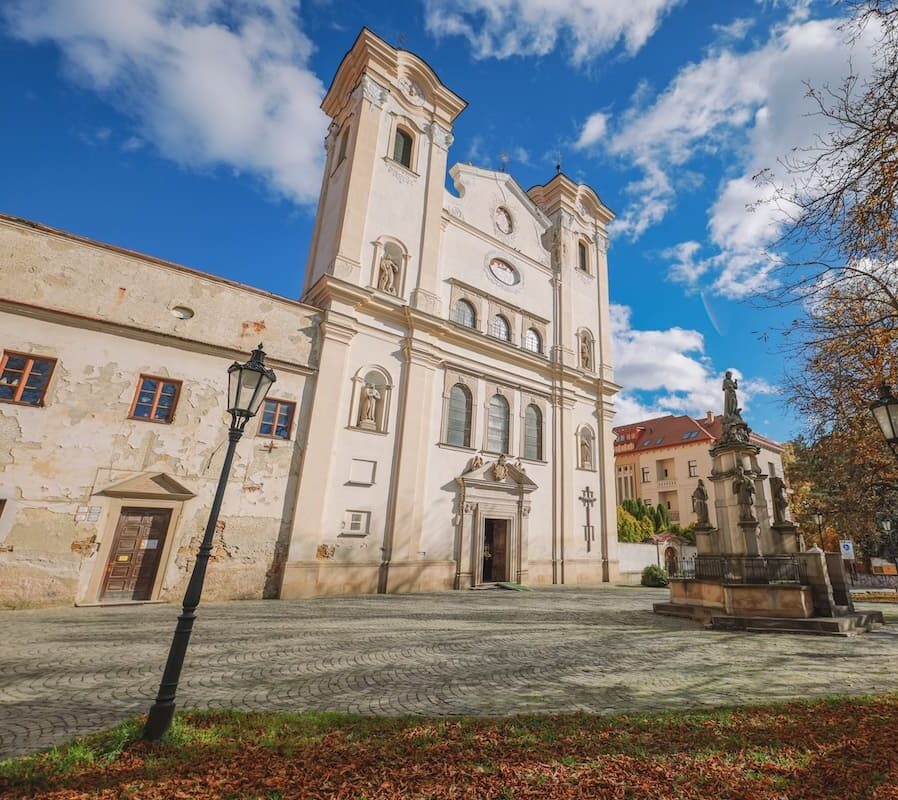
The Franciscan Church of St Joseph is one of the most notable religious monuments in the historic centre of Prešov. It is situated on Franciscan Square off Svätoplukova Street and, together with the adjacent monastery, forms an important historical complex. The church’s present appearance is characterised by Baroque single-nave architecture with a twin-tower façade, which was created by the conversion of an older Gothic church.
From the Carmelites to the Franciscans
The history of the church dates back to the 14th century. Around 1380, the Carmelites built a new church and a small monastery on the site of an older religious building. The medieval building was Gothic in style, with a single nave and a polygonal chancel. After the Carmelites left during the Reformation, the building was taken over by the town, which also used it for agricultural and defensive purposes for a time.
A major turning point came in the 17th century. Under a decree issued by Emperor Leopold I in 1661, the church and monastery were to be handed over to the Franciscans from nearby Nižná Šebastová. However, the monks did not arrive in Prešov until 1671. Following damage sustained during political unrest, extensive restoration and reconstruction of the entire complex took place.
Baroque reconstruction and artistic decoration
From 1708, a major reconstruction of the church took place, giving the church its characteristic Baroque appearance. The façade was remodelled on the model of the Roman Jesuit church, Il Gesù, and two side towers were added. The church was solemnly consecrated in 1735, according to a regional tourist source; Franciscan sources, however, cite the year 1737.
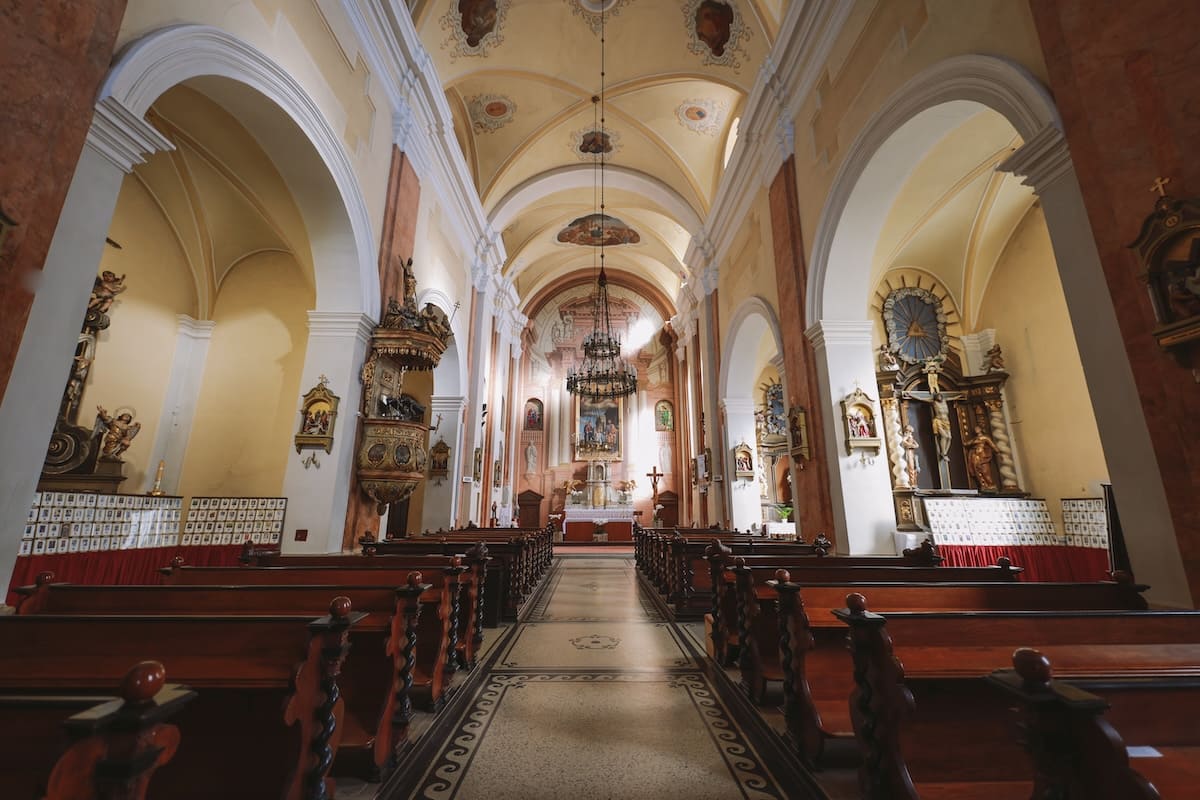
The interior is complemented by side chapels, a Baroque pulpit, historic pews, murals and works of art. The high altar, depicting the Holy Family, is particularly noteworthy, as is the illusionist painting reminiscent of the original 18th-century altar. In the choir loft stands an organ which was converted in 1995 from the original two-manual instrument to a three-manual one.
The Church of St Joseph and the Franciscan tradition
The church is dedicated to Saint Joseph, whose feast day falls on 19 March. The history of the Franciscan Order and its activities in Prešov are closely linked to the church. In the past, the Franciscans also ran a grammar school here, which operated from 1801 to 1852. The complex survived the period of the Josephine reforms and the monastery was not dissolved.
The church has been damaged by fire on several occasions in the past, most notably in 1692, 1870 and 1888. In the fire of 3 December 1888, both towers were destroyed, with only their ruins remaining. Further serious damage was caused by the bombing of Prešov in 1944. Extensive restoration of the church began in 1984 and continued throughout the following decade.
The Franciscan Church of St Joseph today represents a fusion of medieval roots, Baroque architecture and a vibrant spiritual tradition. When visiting historic Prešov, it is an interesting stop not only for lovers of religious architecture, but also for visitors who wish to learn about the history of the town and its religious life.
Source: OOCR RŠ
Source of photographs: OOCR RŠ
Map
Gallery
Information
The Franciscan Church of St Joseph It stands on Františkánske Square, where, together with the monastery, it forms a historically significant complex. The area in front of the church is also complemented by the sculpture of St Roch, which has been in existence since 1733 and is now a listed cultural monument.
Also worth noting is the extensive collection of relics of saints and blessed figures, which is made available to the public in the church on selected occasions, particularly during the novena and octave of All Saints’ Day. :contentReference[oaicite:8]{index=8}
The church is situated right in the historic centre of Prešov, so it is easily accessible on foot from Hlavná Street. A visit can be combined with a tour of other historic monuments in the city centre.
The Franciscan complex remains a vibrant centre of spiritual life to this day. When planning a tour of the interior, it is advisable to take the current liturgical schedule into account and check the availability of visits outside of service times.