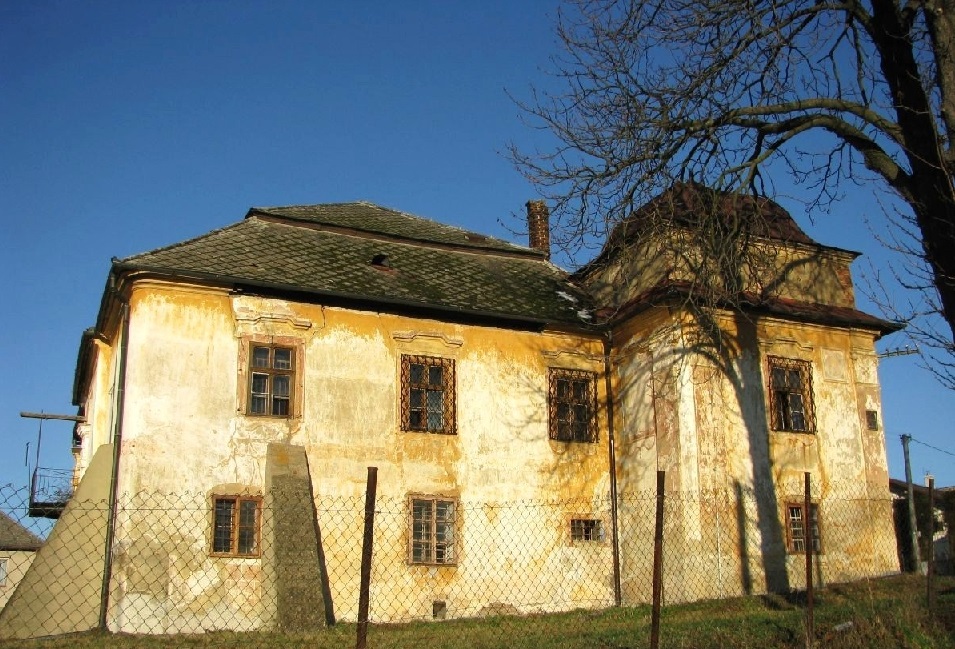

The first mention of the village Pečovská Nová Ves dates from 1319 (Wyfalu). This historically significant village was already the seat of the nobility in the Middle Ages, but it was not until the early modern period that it became the centre of the estate, which necessitated the construction of a manor house. Until 1322, it was royal property; thereafter, it and the surrounding area were owned by the nobleman Mičko, who built his residence high up in the mountains Chergov. Through marriage, further families came to Pečovská Nová Ves, settling in the castles and manor houses in the village, whether they were the Péchy, Mariássy or Bornemisza families.
And thanks to them, Pečovská Nová Ves is exceptionally rich in monuments and historic buildings. In addition to the Baroque church, the Classicist synagogue and the chapel, more than 10 mansions and manor houses, which can be rivalled in Slovakia only by the municipalities of Liptovský Ján or Brezovica. Such a concentration of monuments is unique for rural areas.
In 1556, the Péchy family acquired the aforementioned castle and territorial estate, but they did not choose the old and damaged castle known as Ujvár as their residence, but decided to build a more comfortable residence in a lower position, which was secured as a lowland castle.
The fortified noble residence was built on the left bank terrace of the Torysa River (361 m above sea level), where the terrain slopes south to the valley of the Torysa River and west to the valley of the Ľutinka River. It is a relatively prominent location within the valley with a good view over a large part of the Toryska valley, which was also the route of an important country road.
The appearance of the manor house
The building, which served primarily as a residence, was therefore suitably situated. It is thought that the manor house was intended, to some extent, to protect the nearby Hanig Castle, which is why they also built embrasures there. And manor houses with embrasures were truly a rarity in Slovakia. The building, later known as "Ringov Manor", was first constructed between 1556 and 1563. Neither the deed of donation from 1556 nor its confirmations mention it, meaning it did not exist previously, and it is highly unlikely that the building was constructed by the village’s previous owners (the Tarczay family), as such a significant stone structure would certainly have been mentioned in the deed of donation. An inscription bearing the date has been preserved on a wooden beam in the manor house’s ceiling 20. 6. 1649. The construction in the second half of the 16th century is also evidenced by the architectural details - the rounded profiles of most of the lining of the manor's openings, which are typical for the transition from the Gothic to the Renaissance.
The noble residence was a compact building, in which a tall prismatic tower was incorporated into the irregular ground plan, along with a residential palace featuring a smaller wing at the north-eastern corner. However, unlike the rest of the building, most of the walls of this wing were not made of stone but simply of wooden beams. The thick walls of the building contained more arrow slits than window openings, and even fewer entrances. The building was accessed from the south and, at times, possibly also from the west. The western and southern façades each had approximately four windows with moulded Renaissance jambs; the northern façade had only two, and the eastern façade had no windows at all. Various types of arrowslits clearly predominated on the façades, up to 27 in total (slit, key, leg). They were situated mainly on the upper floors and were strategically arranged and positioned to ensure the most effective defence possible.
The imposing corner tower has survived to this day, and the aforementioned shooting ranges can still be seen there. The individual rooms still feature Renaissance stone doors, Renaissance stucco motifs on the vaults and a Baroque fireplace. From the 19th century onwards, the manor house was apparently no longer the Péchy family’s official residence, and the building was likely simply let out or used for other (e.g. agricultural) purposes.
The interesting feature of this manor house is the fact that it is a building Irish type, which has no equivalent in Slovakia. It is not only the early Renaissance details that are of value, but above all the building as a whole, as it is a very rare type in this country. The closest comparable buildings are the manor houses in Šimonovany and the now-defunct village of Parížovce.
The original plan was for this building to resemble a lowland castle, which is why it was surrounded by a moat. However, it could be said that it is a combination of a castle and a manor house. In the immediate vicinity of the manor house, there are still (structures that are rare by rural standards) – smaller historic terraced houses, dating back to the 19th century at the earliest, which probably served as accommodation for the servants.
Although Ringov Manor House is a relatively little-known historic site, it is of significance not only to the region but to the whole of Slovakia.
Ringo Manor is part of the Šariš Castle Road.
Source: Pečovská Nová Ves Local Authority (Pečovská Nová Ves – A Journey Through History)
Source of photographs: OOCR RŠ
Map
Gallery


Information
„Ringov Manor“ (named after one of its last owners) or, colloquially, „Burdeľ“ (as it served as a castle) is situated on the left-hand side as you head towards the village of Ľutina.
The manor house is surrounded by detached houses; it can be accessed from the west and east via local roads.