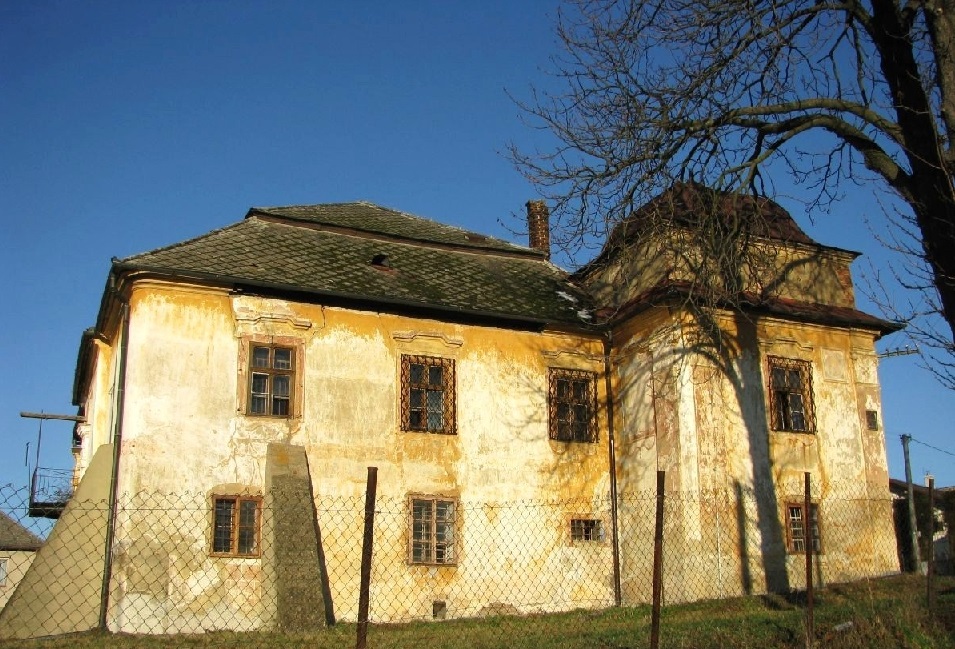

Prehistoric hillfort from the Neolithic, Eneolithic, Hallstatt and medieval periods. It is located north-west of the Močidľany part at 503.0m, on a steep hill The brewery (513 m above sea level), south of the Uzovský Šalgov municipality, which was discovered by Dr. Jozef Repčák. The hillfort itself is located on the north-western edge of the cadastre of the village of Jarovnice. In professional archaeological literature, the location of Várheď (often also Várhegy) is associated not only with Jarovnice or Močidľany, which is now a local part of Jarovnice, but also often with Uzovský Šalgov. There is a simple explanation for this, Várheď is the closest to Várheď from Uzovské Šalgov and also for a certain period in the Middle Ages Várheď belonged to the owners of Uzovské Šalgov. To this day, the owners of the forest on Várhedy are citizens, or at least natives, of Uzovské Šalgov.
The oval platform of the hill fort on the Várheď hill was first inhabited in the Younger Stone Age (Neolithic; 6000-3300 BC). First by the people of a culture with eastern linear pottery, its younger stage, referred to as the Tiszadob group. We can roughly date the residence of the first peasants to the 2nd half of the 5th millennium BC. However, the most intensive Neolithic phase of the settlement of Várheď is associated with the people of the Bukov Mountain culture, as evidenced by the settlement finds discovered during the reconnaissance research of Vojtech Budinský-Krička of the Institute of Archaeology of the Slovak Academy of Sciences in 1954. The Bukovohorská culture was formed in the last centuries of the 5th millennium BC, in the Šarišské Podolí region on the bedrock of the Tiszadob group, with an increasing intensity of settlement. Settlement finds of the Bukov Mountain culture have also been found in the cadastres of villages close to Uzovské Šalgov, e.g. in Jarovnice, Ražňany and Ostrovany.
The people of the Bukov Mountain culture took advantage of the elevated position of the Várheď hill and, according to the results of research, it is reported that they created two artificial settlement terraces on the southern side of the hill, below the acropolis. Várheď was used at least as a refugium and served as a temporary settlement only in times of danger as a refuge.
In the next phase of prehistoric times neither Várheď nor Šarišské podolie was inhabited. The re-population dates back to the Late Stone Age (Eneolithic; 3300-1900 BC) by the people of the Baden culture in the middle phase of the Eneolithic. Finds of the Baden culture have also been found in the neighbouring cadastre of the village of Ražňany, where a large open settlement is presumed on the area of the airfield.
Várheď was inhabited much more intensively in the Early and Late Bronze Age (1200 - 700 BC). The people who settled here are said to be the bearers of the receding Pilin culture, which was influenced by the Lusatian cultural complex and the Gavian culture. The next phase of settlement on Várheď Hill is assumed to be in the earlier Iron Age (Hallstatt period; 700-400 BC). The construction of a massive ditch on the lower southern terrace is also attributed to this phase, and the existence of a mound can also be assumed.
The connection between the Late Bronze Age and Early Iron Age settlements is not sufficiently clear, as the findings from the survey research have not been specifically published, or the only mention of them is in Article V. Budinský-Krička in Slovak Archaeology (1961), where they are referred to as finds from the „Hallstatt Age“. However, it is possible that these are the same finds, which have only been assigned to different cultures.
A very important site for the knowledge of the Roman period (0 - 400 AD) is the site in the position Nad Imunou on the border of the villages Ostrovany and Medzany. It is a settlement that was the craft and probably also political centre of a wider area (at least the territory of the Upper and Middle Torsy) in the Younger Roman period. Its importance is not only proved by the settlement findings from systematic archaeological excavations in 1983, 1986-1992. The precious relics discovered in the two princely graves in Ostrovany, which were unfortunately found as early as 1790 and 1865 (they are in the collections of the Kunsthistorisches Museum in Vienna and the Hungarian National Museum in Budapest), are of high testimonial value in themselves. The contents of both graves are not only testimony to the existence of a princely class, but also evidence of the economic prosperity of the region in the early Roman period. It is assumed that an important settlement and economic „agglomeration“ stretched along the right terrace of the River Torysa from Medziany through Ostrovany to Ražňany for several kilometres. The most important economic activities of the inhabitants of the settlement in the Nad Imunou location were the production of so-called grey pottery (a domestic parallel of the luxurious Roman terra sigillata) and metallurgical activities. The contact of the island settlement with the territory of the Roman Empire is evidenced by the products of a foreign province (terra sigillata, clasps) and coins from the period of the Roman Empire.
Source: municipality Uzovský Šalgov
Photo:hiking.sk
Map
Gallery