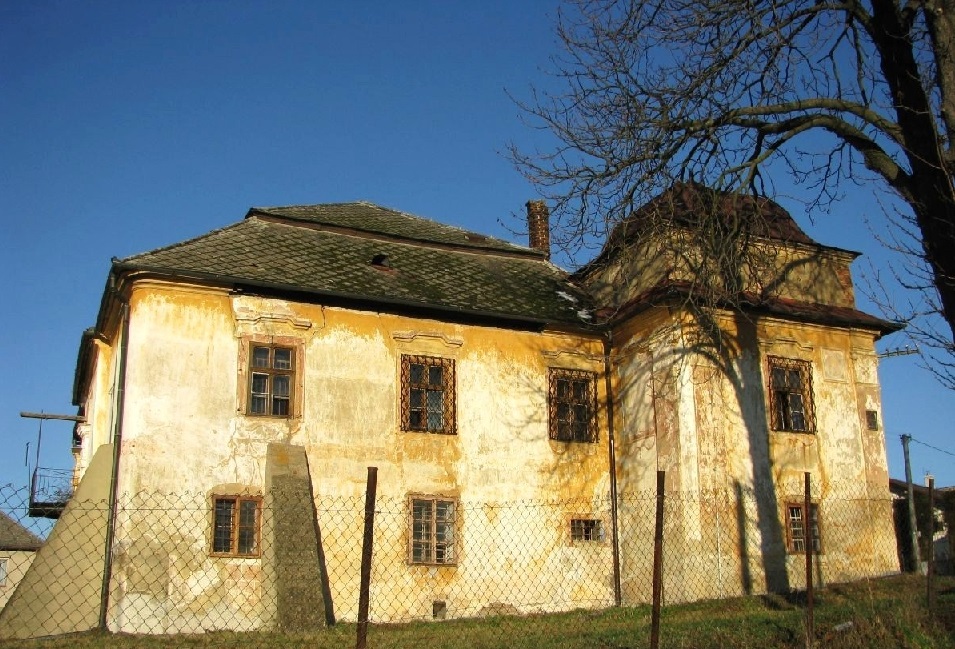

The circumstances of the castle's origin are not clear. One of the theories claims that the origin is related to the royal hunting with falcons. Another possibility is the connection of the castle's foundation with the Tatar invasion. The period after the Tartar invasion, i.e. after 1241, was a boom in the construction of stone castles, especially in inaccessible terrain. Sokole Castle, with its typology, layout and architectural level, belongs to the castles built in the second half of the 13th century. As it is hidden high in the mountains, in a dense forest, a strategic location is out of the question. Rather, it had the character of a refuge not only for the local landlords, but also for the large population in case of a sudden return of the Mongol troops (such was also the character of the castles in Obišovce, Skáros and Slanské vrchy).
The first written mention of the castle found so far is in a charter from 1299 and in the reverse of the Omodei family from 1311, in which it is mentioned as one of the border castles of the Montenegro Mountains.
In 1405 King Sigismund declared the castle royal. A charter from 1423 states that King Sigismund gave the castle to Matúš and Imrich of Pavlovice. The castle (then located in the Šarišská stoica) he handed over to them with all the accessories (except for the village of Kavečany, which he gave to Košice). The ownership of Sokole Castle included the villages of Sokole (Zakolya), Kostoľany nad Hornádom (Zenthestwan), Malá Vieska (Wyfalu), Tepličany (Tapilczan), Rokycany (Berky), Biskád (Bykzad), an extinct village of unknown location, Ružín (Rwsynch), Malá Lodina (Felsew Landa), and Veľká Lodina (Also Landa). According to this deed of 1423, both the castle and the village of Sokole were also of commercial importance. In the village, toll was paid for timber - rafts floating on the Hornád.
Subsequently, King Sigismund donated the castle to the town of Košice in 1429. The condition of the donation was that the castle would collapse. It was therefore most probably burnt down and partially demolished to make it impossible for groups of brigands, for example, to take refuge in it. In 1440 the castle is already mentioned as a ruin.
According to the remains found, it can be concluded that it was a small castle, which had a watchtower and a castle palace. A medieval well is clearly visible in the courtyard. It was probably inhabited by falconers who tamed and bred falcons for royal hunts. Nowadays, Sokolov castle resembles only an inconspicuous rampart with a moat and a torso of tiny stones. The castle moat is the most remarkable remnant.
Under the castle there is the Castle Cave, which is about 27 metres long. The cave lies in the northeastern slope about 10 to 12 metres below the castle. It is a combined cavity of a man-made tunnel and a cave. The castle cave is probably largely an artificially cut passage, heading approximately to the centre of the castle, under the tower. It probably served as a cellar. In winter it is home to bats.
At present, the castle and the cellar cave are looked after by Municipality Sokole and Civic Association Dedinka, who together built a nature trail leading from the village of Sokole.
Photo: VKA, FB Sokol Castle
Gallery