

... “ait is precisely by reverence that man would differentiate himself from the animal....“
Every nation has its greats who have gone down in history and children learn about them in schools. Not all of them have made it into the textbooks. Some are mentioned in encyclopedias, others in historical facts, many in various rankings. In every city you will find monuments that belong to the personalities who lived in them, created, contributed to their development. Rarely is it anymore to mention and draw attention to a personality who has contributed to the preservation of the traditions and awareness of a region in Slovakia.
29.9.1920 Ján Lazorík, ethnographer, collector, dialectologist, writer, collector, archivist, museum keeper, but also botanist and fruit grower, was born. A man who deserves, at least in the regional consciousness, recognition, respect and remembrance.

Born before 100 years ago in the village of Torysa. He completed his studies at the state grammar school and the Teacher's Institute in Prešov. He worked as a teacher in Vysoká, Brezovička and Krivany, where he founded fruit breeding stations. He ended his more than 20-year activity in the Natural History Station in Šarišské Michaľany, which was moved in 1967 to Kolman's Garden in Prešov, to the location Pod Kalváriou.
He was known far and wide folklorist, ethnographer to the bone, a tireless fighter for traditional Slovak culture. As a person living in connection with nature, he had an innate sensitivity to its perception in symbiosis with folk art. Accented, that nature and folk art are the same genius, the same miracle of variety and contrast.
And so he lived. Saving a national treasure.He walked tirelessly with a violin under his arm, a tape recorder, a camera and his unforgettable „scripts“ from village to village, where he notated folk songs, wrote down people's narratives about life, without the influence of technology. He documented and instilled remembered the oldest language of the people in his region and collected an incredible number of artefacts of folk culture, which he saved from destruction and eventually donated to museums, scientific institutions or municipalities in the preparation of their monographs. Uploaded by old local philosophers and singers, he wrote not only local customs, weddings, superstitions or fairy tales, but also stories of old craftsmen (carpenters, furnace makers, stucco makers, plasterers) and war veterans. Saved by documents and objects of sacral and historical-artistic character from notariats, parishes, manor houses. Documented by crafts, emigration, tinkering, and above all he collected everything old and museum-quality - work tools, handicraft and art-industrial products, historical prints, original costume parts. There is so much that academician Mikuláš Mušinka once said:
„What Ján Lazorík has done on his own, without any scientific research grant, could be the work of an entire scientific research institution, and the activities of such an institution would be considered very successful.“. The idea is wonderful and if it happened who knows how he would react.

He was a true To the Šarišans, who sought to open the door to life Shariste and other dialects. Šariš dialect loved and perceived as a phenomenon that draws people into another dimension, into a space of humanity, warmth, interest and gender. He took it as his goal to preserve it asSharis heritage. He valued written languages as a necessity, but he considered them artificial because he saw them as a limited choice of words, while dialects for him meant otherness, diversity, and he often claimed that some words could not be expressed in Slovak. For example, the imperative form of the wordgrow ( grow up), in the Sharīʿah exists: „roshni !“ He compared the disappearance of dialects as such to natural tragedies, the extinction of some animal species, or the loss of the ozone layer in the atmosphere.
From 1992 to 2015published 24 books, mostly in the nativeSharis dialect, documenting an extraordinarily difficult but spiritually rich life in the past, with authentic photographs and sheet music. Each book is a treasure and a documentation of the Šariš region, written in the original Sharis dialect, is a value that will last, returning you to the times of your ancestors and showing you the beauty of this singing dialect. Regional Museum in Prešov published five titles of Šariš customs from its fund in the edition Spiritual Pearls of the Šariš Dialect. His works are still on sale and available in Regional Museum in Prešov, the Municipal Information Centre Prešov and the Municipal Office in Krivany.
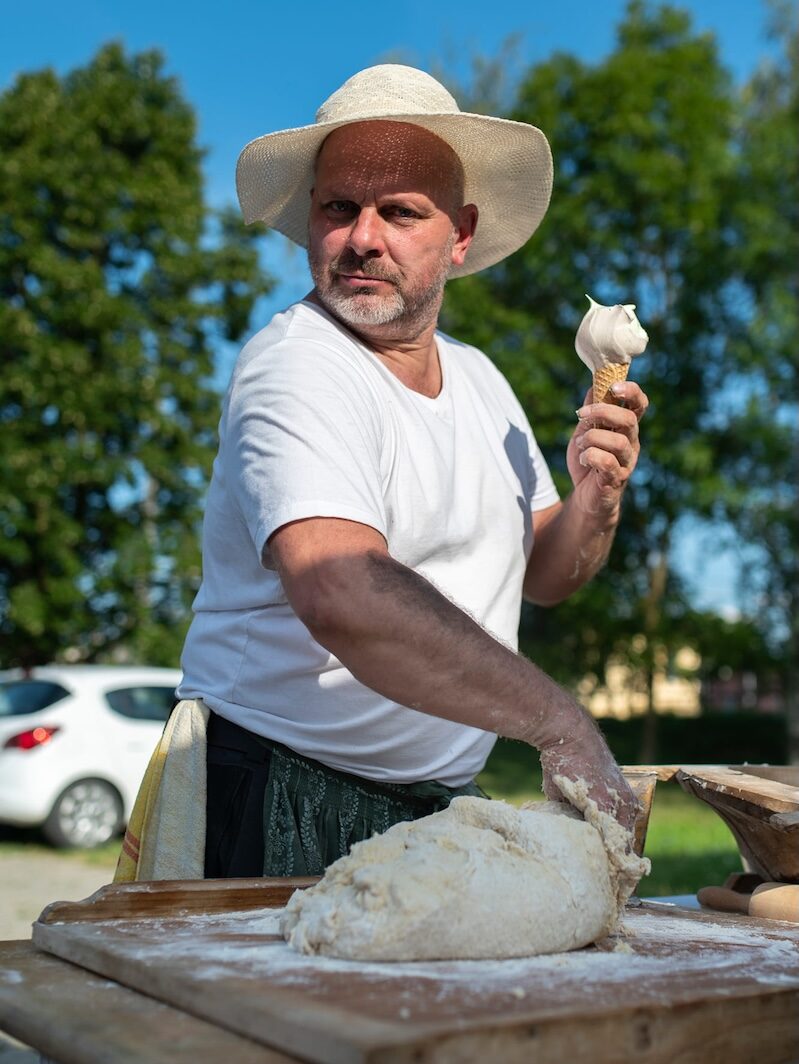
A number of three-dimensional objects from the field of traditional folk culture obtained Regional Museum in Prešov are currently part of the ethnographic collection of Ján Lazorík and his permanent ethnographic exhibition. The museum has realized five thematic travelling exhibitions. The last of them, Bread making in the photography of Jan Lazorik, was a contribution to his untimely birthday. It was prepared by the Regional Museum in Prešov with the financial support of the municipality of Krivany. V Centre of Folk Culture and Crafts in Krivany you will find an installed exhibition in an adapted stone granary with authentic period photographs and textual processing illustratively specifying the original function of individual exhibits / threshing machines, grain cleaners, sowing machines, etc./. Unique images include objects that no longer exist, which in the past were an integral part of the homestead or village. Apart from granaries and barns, these were mainly mills, which completed the cycle of bread production before baking.
Ján Lazorík passed away on August 30, 2015, a few weeks before he turned 95 years old.divided in memoriam Pribinov cross II. class „for exceptional merits for the cultural development of the Slovak Republic in the field of folk art and folklore“
„The greatness of a man lies in his thinking,“ said the French writer and Christian philosopher Blaise Pascal. Ján Lazorík was undoubtedly a great man in the Šariš region.

A selection of highlights from his work, as well as from his life and thoughts to ponder:
- Collected more like 270 ! derogatory names on masculine ? As a groper, a mirdajric, a giant? A „only“ 60 derogatory feminine names? Like rochľa, piskuľa, lapštiga (source: book Humor- true pictures from the old “dzedzini“ 1. a 2. part - Ján Lazorik(2006)
- When he lost his notes and couldn't come to terms with the loss. He wrote babe Vange, a Bulgarian blind fortune-teller, to see if she could help him find the notebook with his notes. She replied that she couldn't help or advise him, the notebook had just fallen to the ground...
- They tormented him with words, if anyone said that certain - higher - states of mind cannot be expressed in dialect, or that the dialect does not have today's literary terms such as impression, concept, imagination, meaning.
- He hoped that the more time passed, the the monuments will be rarer, more admired. The opposite happened. He argued that the nation was feeding on materialism and foreignness, the natives were ashamed of their mother tongue, and the children were slowly becoming unaware that their ancestors had been here.
- As a teacher of Slovak, he daily regretted to his pupils that they had to learn many unnatural things. He wondered why grain is written with a soft i, but herb with a ypsilon, similarly with the words quadrille and quadrille. He therefore considered the Slovak language and its spelling to be one of the most difficult in the world and wanted, once and for all, toygumovat from the Slovak spelling of the hated ypsilon. In 1967, he was at a meeting at the Linguistic Institute of the Ľudovít Štúr Slovak Academy of Sciences. He came back with the news that the ypsilon would finally be abolished. It didn't.
- “ ...humanity can save itself only by living according to nature, its laws, by preserving diversity as a principle of creation and the meaning of life...“ ( Ján Lazorík)
- „...it is by reverence that man is distinguished from the animal....“ (Ján Lazorík)
- “No one has ever become more beautiful by changing their face.“ (Ján Lazorík)
- „ so as nature fashions her little birds, crabs and beetles - but there is such a field, that every flower is different, and if the terraces are fashions on one panel, one fashion, one pop-music, one written language changes - there is nothing to live for, to learn, oh, our God, who will save this dumbed-down world?!“ (Ján Lazorík)