

The village of Hermanovce is situated in a narrow valley of the Hermanovský brook, 20 km from the town of Prešov.
„Villa Hermani Superior et Inferior - Settlement Hermanovce Upper and Lower“ - This is the first written mention of Hermanovce, when the information appeared in historical sources on 21 February 1320 in connection with the division of the hereditary estates of Mikuláš Merše of Svinja.
After the Tatar invasions, around 1242, the abandoned estates were occupied by new nobles and loyal soldiers. Probably at that time, the German Hermann, who became a schoolmaster in the territory of today's Hermanovce, probably came to the territory of Upper Hungary. An interesting fact about Hermanovce is that for many centuries it was actually two villages, Upper and Lower Hermanovce - later called Šemšey Hermanovce and Stankay Hermanovce. One part belonged to the landowners from Šebeš (since 1372) the other from Šemše (since 1426). Both villages were separated by the Hermanka stream. The village is said to have had two richtars and two cemeteries. However, there was a common church. Historical sources show that Hermanovce changed hands several times - the families of Chirke, Synka or Sinka, Sebessy, Šemšey, Bertoty, Forgach, Usz, Sztankay, Révesz changed hands. The two villages were merged in the 18th century, when they belonged to the Pechy family.
The Pécha family moved to eastern Hungary, today's eastern Slovakia, after the Turkish invasions. Their main possessions included Pečovská Nová Ves and its surroundings.
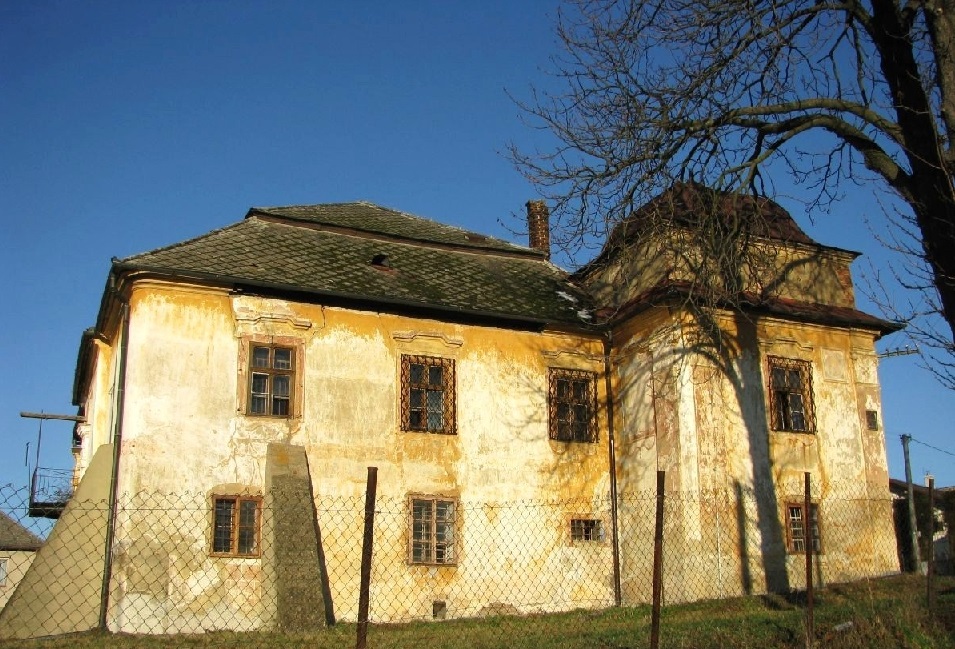
The story of Péchy Manor began around 1772, when the landlords and patrons were Ladislaus Péchy, the royal privy councillor during the reign of Empress Maria Theresa, and his wife Žofia Úsz. The story of Franciscus Péchy, who was an imperial commissioner and ruled over the surrounding villages, is recorded as a story of great love. When Franciscus asked for the hand of the daughter of the landowner of Bardejov, Barbora Bereczská, he was told that she would be happy to come, but let him build her a new manor house on the hill. The wish was fulfilled for the beloved Barbora and she repaid her husband and the village by having a beautiful church built opposite the manor house with a high altar from the school of Master Paul. In 1818 she also had a mausoleum built on six stone pillars with a stone dome in front of the main entrance to the church. The two coffins of Franciscus Péchy and his wife Barbara can still be found under the mausoleum. The manor house used to include a three-hectare English park, lord's court, distillery, vast forests and arable lands. The owner had a Hunting House, a tennis court and a generous natural swimming pool by the stream built on the grounds for the family. Until 1948, his wife Klara, née Klára, still lived in part of the manor. Bánó de Tapolylucska et Kükemezö with her daughter Klara. Their houses served as a school, but over the years they became ruins.
In the 1990s, the descendants regained part of the original property and made it their life's work to save and preserve the family heritage - the park, the houses and the forests. Today, the manor house is in the hands of the successors of the Péchy family Kláry Szakall von Losoncz, who is the granddaughter of the last owners and who contributed to the present state of the manor. The manor house is currently a hotel and is the only manor house in Slovakia awarded as one of the seven the most romantic hotels in Europe.
Hermanovce Manor is part of the Šariš castle roads.
Source /photo: Pechy Manor Hermanovce
Map
Gallery