

The north-east of Šariš appears peaceful today – green valleys, small villages, wooden churches and roads winding beneath the Dukla Pass. But if you look a little more closely, you will realise that the landscape is literally criss-crossed with traces of war. Military cemeteries, memorials, tanks, trenches and the stories of fallen soldiers serve as a reminder that some of the fiercest battles of both world wars on the territory of present-day Slovakia took place right here. So come along with us In the footsteps of the wars in the north-east of Šariš.

The route takes us from the inconspicuous military graves in Krajné Čierne, through Ladomírová, to the Valley of Death, where the bloody battles of the Carpathian-Dukla Operation took place in 1944. Be inspired by this journey through military history and follow in the footsteps of the filming of our new videos, which form part of rebranding to mark the 10th anniversary of the OOCR Šariš Region.
Krajné Čierno and its history
Let’s start at the very edge and begin in the village of Krajné Čierno. This small village in the district of Svidník harbours fragments of its wartime history right there in the local cemetery. It is situated right next to a wooden The Church of St Basil the Great, which in 2000 was included by the World Monuments Fund on its list of the world’s 100 most endangered monuments. During the Second World War, in the battles for the Dukla Pass, both the village and the church were severely damaged. In the cemetery next to the church, there are four graves of soldiers who fell in the First World War, in which a total of five men are buried. Their bodies were found on private land in the village, exhumed and transferred to the local cemetery.

Ladomírová – war memorials and a UNESCO World Heritage Site
From Krajné Čierna, we move on to the neighbouring village of Ladomírová, which is also linked to the First World War. Evidence of this is the Military Cemetery for Unknown Soldiers from the First World War, where 270 soldiers are buried.
The village also has a wooden The Church of St Michael the Archangel, which has been inscribed on the UNESCO World Heritage List since 2008. The church’s architecture combines elements of the Lemko, Russian-Byzantine and Eastern Carpathian traditions, giving it a distinctive architectural character.
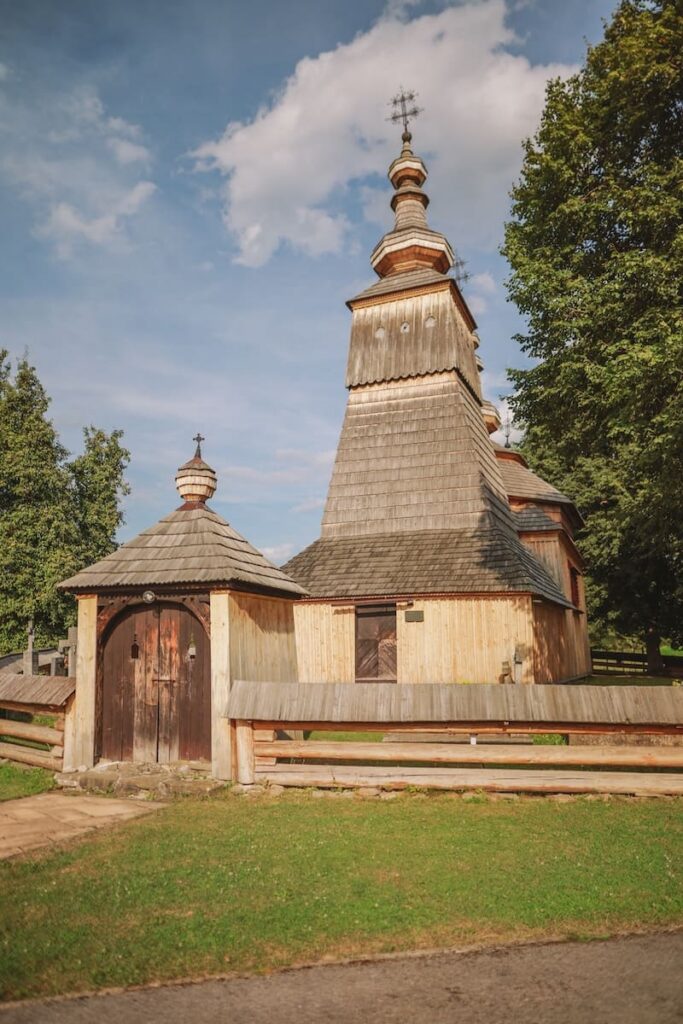
The complex also includes a wooden bell tower of a columnar design, which stands on the south side of the church. Its history is also linked to an important monastery with a printing press, which was founded here after the 1917 revolution by Russian and Ukrainian Orthodox monks. The monastery became a spiritual and cultural centre, but was destroyed after the Second World War. The church itself was not spared from damage, but the damage was repaired and, despite these events, a substantial part of the church’s historic appearance has been preserved.
The Valley of Death near Svidník
We’ll head towards the town Svidník, but we won’t be going into the town itself. At the crossroads, we’ll turn off towards the village of Kapišová, as our destination is the Dukla Battlefield Nature Reserve, known as Death Valley.
The Valley of Death is a historic area in the district of Svidník, where the bloody battles of the Carpathian-Dukla Offensive took place in October 1944 during the Second World War. It is situated in the valley of the Kapišovka stream and stretches between the villages of Dlhoňa, Dobroslava, Havranec, Kapišová, Kružlová, Nižná Pisaná, Svidnička, Vápeník and Vyšná Pisaná.
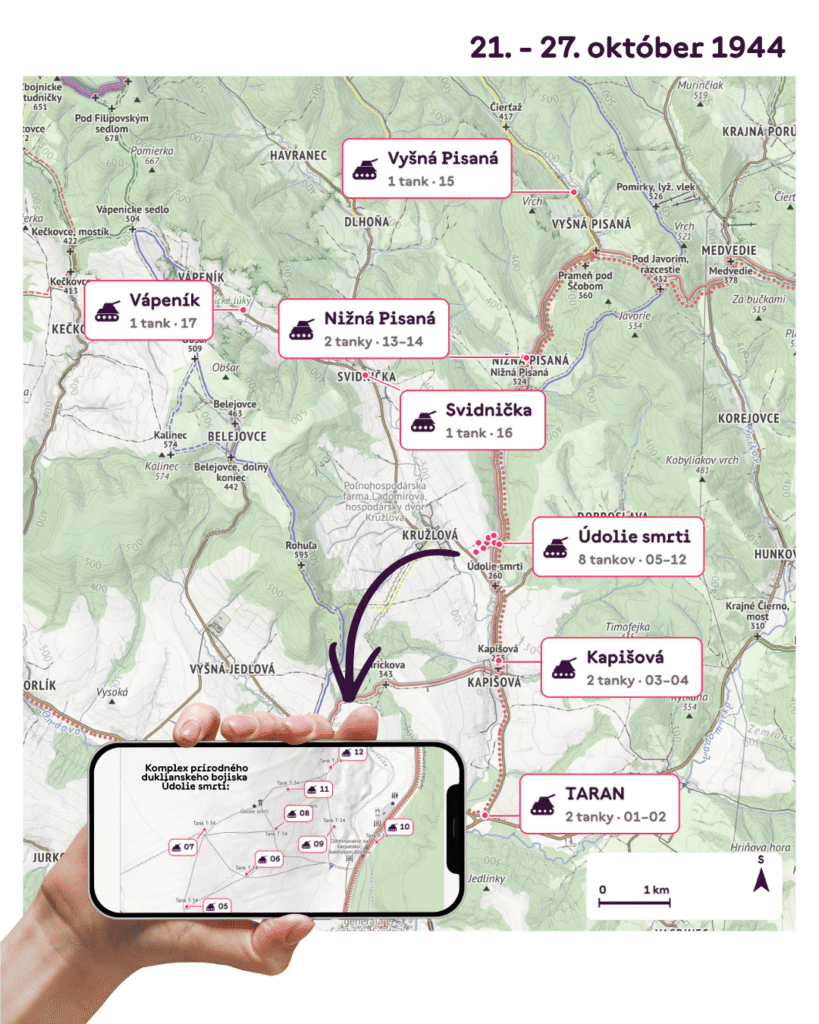
Between 21 and 27 October 1944, heavy fighting took place here between Soviet troops and a German division as part of the Carpathian-Dukla Offensive, aimed at liberating Czechoslovakia from Nazi forces. The fighting was characterised by heavy casualties on both sides, inclement autumn weather and difficult, waterlogged terrain, which slowed the advance of tanks and infantry. In total, up to 11,000 soldiers were killed, of whom approximately 5,000 were Soviet.
The TARAN Memorial
After the junction, we shall stop at the Central Memorial to Tank Crews, known as the TARAN Memorial. The memorial is dedicated to the tank crews who took part in the fighting during the Carpathian-Dukla Operation. More than 120,000 Allied soldiers were deployed in the operation, facing around 100,000 Germans in well-fortified mountain passes.

In the wake of the tanks and fierce fighting
We will continue our journey through Kapišová, where there is a memorial to the Soviet officer Pavel Andreyevich Tolstel, who fell during the fighting in 1944. The memorial was restored in 2021 and two T-34-85 tanks stand nearby.
From Kapišová, we’ll head to the Valley of Death near Nižná Pisana. Here, there is a unique installation of eight T-34 tanks, commemorating the battles of the Carpathian-Dukla Offensive. The site also features memorials, trenches, information boards and a 13.5-metre-high observation tower shaped like a vz. 24 rifle cartridge, built in 2021. From the top, there is a view over the entire valley and the surroundings of the Dukla Pass. The site is accessible on foot, by bike or by car.
To continue exploring military history, you can head to Vyšná and Nižná Pisana, where there are more T-34 tanks, or via Svidnička to Vápeník, where you’ll find further military artefacts.
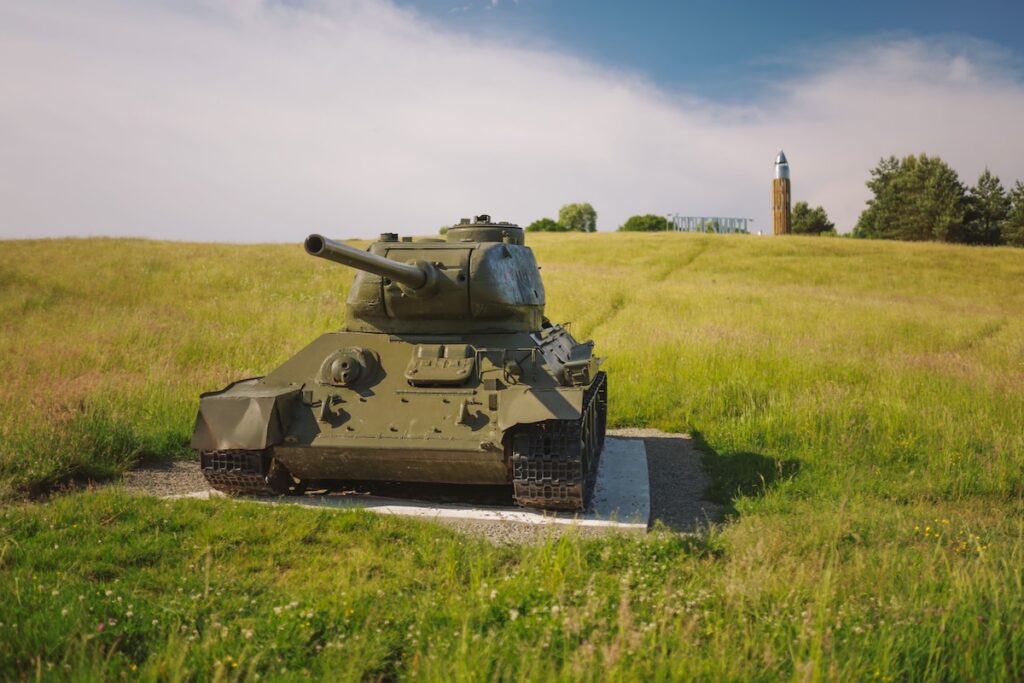
Today, the landscape of Death Valley appears peaceful, but it was here that fierce fighting took place in 1944. Memorials, military cemeteries, trenches and tanks serve as a reminder not only of the course of the war, but above all of the people who paid the ultimate price for it.
We are not setting out to follow in the footsteps of the wars in the north-east of Šariš in order to admire war, but to understand it better. And perhaps, as we look out over today’s peaceful countryside, we will become a little more aware of the value of peace, which we now take for granted.
Source: OOCR RŠ
Source of photographs: OOCR RŠ