

The salt spring in what is now Solivar was already in use as early as 1223 and, owing to its value, constituted a significant asset. In 1288, King Ladislaus IV of Hungary bestowed it upon the nobleman Juraj, whose descendants began to use the name The Šóšov family.
Their estates stretched from Torysa through Slanské vrchy as far as the River Topľa. In 1346, a court confirmed their claim to part of the territory of today’s Hanušovce nad Topľou, which had already been granted town status in 1332.
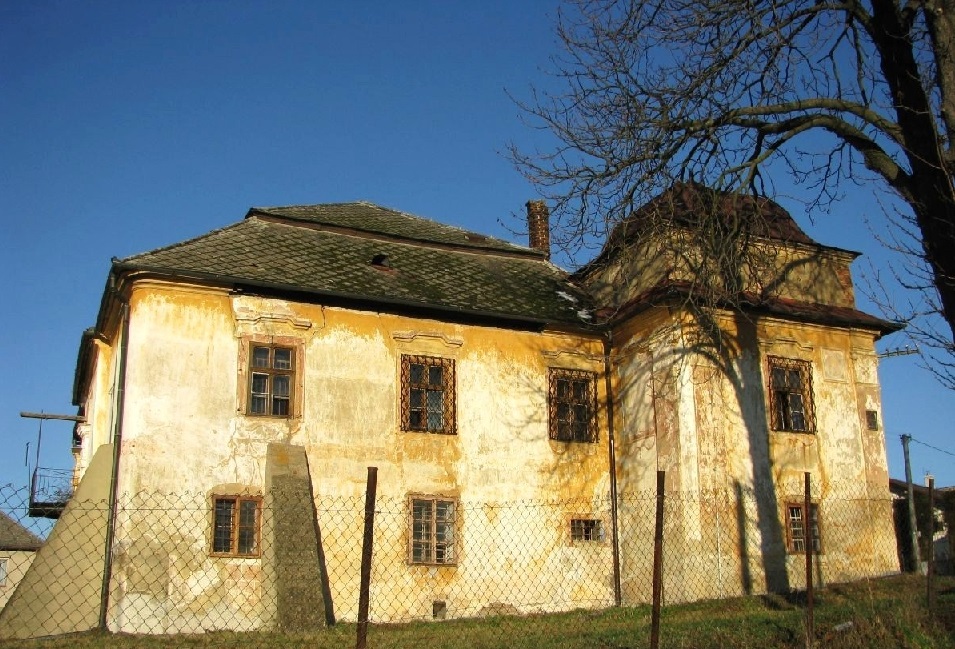
The small manor house in Hanušovce nad Topľou It had been the property and ancestral seat of the Šóšovci family of the „Soľnobanský“ line since at least 1564, and after 1592 it was their sole ancestral seat following the destruction of the castle above Soľná Baňa.
The appearance of the manor house
It was built as a two-storey block structure exhibiting all the architectural features of the period (layout, stonework and sgraffito decoration) typical of a stately noble residence intended as a home for the landowner and his family. At the time of its construction, the manor house was finished with smooth lime plaster featuring typical corner leaf sgraffito.
Moulded stone jambs were fitted in the window openings, and in the main entrance there is a stone portal in the lintel bearing the inscription: SOOS STEPHANUS YES 1564. The stone cells were later removed and used as secondary building material. In connection with the beginning of the anti-Habsburg uprisings in Hungary at the beginning of the 17th century. A round tower was added to the southern corner of the manor to increase its defensibility. The construction of the tower changed the character of the manor into a residential and defensive residence. During the 17th century, the residential function gained a new identity. prevailed over the fortification function. The guns as a defensive element have not been preserved. Later, the window openings and the stucco decoration of the vaults were modified. The stucco decoration of the vaults is preserved throughout the entire extent of the first floor.
The manor house took on its final Renaissance appearance at the end of the 17th century. In the period that followed, the Dežöfi family, amongst others, emerged as the owners of the estates in Hanušovce nad Topľou; they built a house on a hill not far from the Small Manor House a new Baroque manor house with Renaissance features. It is said that the farm building next to the Small Manor House was used as the caretaker’s flat for the new manor house.
Given that the new landowners of Hanušovce nad Topľou lived in a new, far more stately manor house, and that the building adjoining the Small Manor House had been converted into the steward’s residence, it can be assumed that the so-called ‘Small Manor House’ was also intended at that time for more minor, perhaps farm-related, or possibly residential purposes, though clearly not for the accommodation of members of the landowning family.
In the manor house, until 1711, the year of the death of a nobleman named „Joan de Soóso“, there was probably also the family archive of the Šoš family. The aforementioned Joan, Ján in Slovak, has been buried since 1711 under the pavement of what is now the Roman Catholic church in Hanušovce nad Topľou, about 50 m from his manor house. It is announced by a Latin inscription carved into a stone slab.
Today, Šóšovsky Manor (the Small Manor) is used for cultural and social activities, as a library and gallery, and as a small concert hall.
Šošovský manor house is part of the Šariš castle roads
Source: The Town of Hanušovce nad Topľou
Source of photographs: OOCR RŠ
Map
Information
The small manor house, also known as Šóšovský Manor, is situated in the centre of Hanušovce nad Topľou at Zámocká 150/2. It is situated not far from the Grand Manor House and can be easily reached on foot from the town centre. Enter „Šóšovský Manor House“ or „Hanušovce nad Topľou Municipal Cultural Centre“ into your sat-nav.
The building houses the municipal cultural centre and the municipal library; it is therefore not a traditional museum with regular guided tours.
If you are interested in a viewing, we recommend that you contact the property managers.