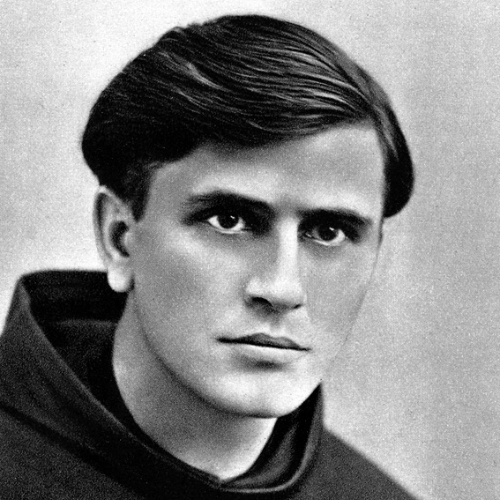

He was born on 1 August 1905 in Trstena, Orava, where he graduated from the gymnasium. After graduation he became a monk of the Franciscan Order and worked in monasteries in Kremnica, Hlohovec, Malacky and Žilina. He studied Catholic theology and became a priest. Subsequently, he worked as a secondary school teacher of religion in several towns, including an evangelical college in Prešov in the second half of the 1930s. After the outbreak of World War II, he volunteered as a field curator on the Eastern Front.
Returning from the front in the autumn of 1944, he spent five months in the Franciscan monastery in Nižná Šebastová near Prešov. After the war he emigrated, first to Rome and from there to Argentina, where from 1947 he was a priest of the Slovak emigrants in Buenos Aires and edited the magazine Slovenské zvesti (Slovak Tidings). From 1965 he lived in a monastery in Pittsburgh, USA, where he was the editor of the Letters of St. Francis, but also an official of the World Congress of Slovaks. In 1969 he visited Slovakia with the intention of staying, but eventually returned to the USA. He died in Pittsburgh on April 7, 1986.
Dilong is one of the leading representatives of Slovak Catholic modernism, whose work includes more than one hundred collections of poetry. His life and work were marked by his „forbidden“ love for a woman of Jewish origin, Vali, during the time of anti-Semitism. He entered literature as a co-founder of the magazine Postup. In his first three collections of poetry, Future People, Gloriously on stilts, Breathe lazy! he portrayed the theme of nature and peasant life through a traditional rustic vision. In the collections Helena Wears a Lily and The Young Bridegroom one can identify the influences of Czech poetism. Later, struck by the horrors of war, Dilong resorted in his collections to the themes of childhood and his native Orava, which he saw as a security in times of war.
His work was of a spiritual meditative character, and his book I, Saint Francis is considered to be its culmination. In exile he published more than 70 collections. A selection of his exiled works was published after 1989 under the title I, Rudolf Dilong, troubadour and bears witness to his bitter plight as an outcast and separated from his homeland. His most recent works include the unfinished prose work Ruža Dagmar.
There is a street named after him in Prešov.
Source: Regional Library P. O. Hviezdoslav in Prešov; Micro-project.
Photo source: Author Slovak Bookshop, Prague - The Pictures of Slovak Writers Serie, vol. 1 (The Pictures of Slovak Writers Series, Series 1), Free work, https://commons.wikimedia.org/w/index.php?curid=10679310
Information
literary works, theology